
Judiciary
FG Commences Mass Trial of Terrorism Suspects in Abuja

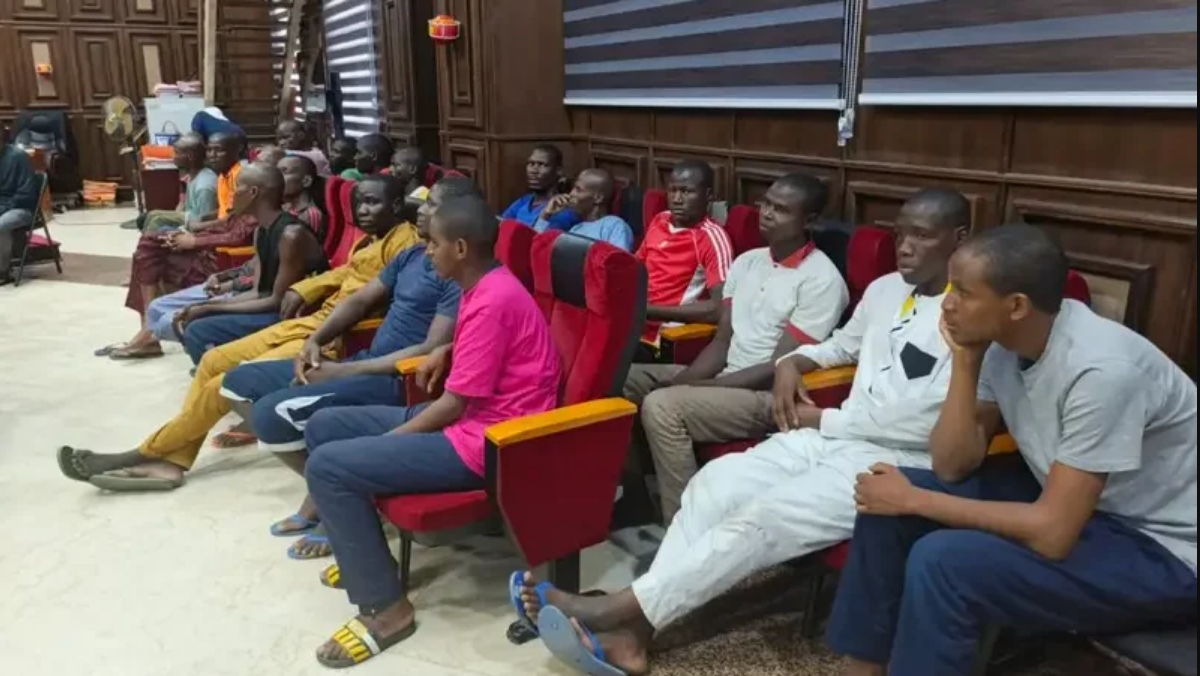
The Federal Government on Tuesday commenced the mass trial of 227 terrorism suspects before the Federal High Court sitting in Abuja.
The trials of the suspects—who, according to the Attorney General of the Federation (AGF) and Minister of Justice, Prince Lateef Fagbemi, SAN, number about 500—are being handled by ten judges of the Federal High Court in Abuja.
The trial of terrorism suspects, which usually takes place in Kainji, Niger State, was moved to Abuja as the court is currently on Easter vacation, which began on Tuesday, April 7, and will end on April 13, 2026. Regular court sittings will resume on Tuesday, April 14, across all divisions of the Federal High Court.
While the AGF, the Director of Public Prosecutions of the Federation (DPPF), Rotimi Oyedepo, SAN, and Becky Jibo, Chief State Counsel, appeared for the prosecution, the Director-General of the Legal Aid Council of Nigeria represented some of the suspects.
The first suspect, Hamat Modu, aged 20, who pleaded guilty to a four-count charge bordering on rendering assistance to members of Boko Haram—a proscribed group in the country—was convicted and sentenced by Justice Binta Nyako to ten years’ imprisonment on each count.
In another case, Isah Ali, also a food supplier in Borno State, who pleaded guilty to the charges preferred against him, was handed a ten-year jail term by Justice Nyako. The judge ruled that his sentence would take effect from three years ago when he was arrested and detained.
Justice Nyako also ordered that the convicts be held in any detention facility designated by the Ministry of Interior and undergo rehabilitation and deradicalisation at the end of their jail terms.
During Tuesday’s proceedings, Justice Nyako also sentenced a father of six, Hamza Yahuza, to seven years’ imprisonment for selling Indian hemp and cigarettes to Boko Haram terrorists in Borno State.
Yahuza, one of over 500 persons brought before various Federal High Court divisions in Abuja for trial by the AGF for aiding and abetting terrorism against the Federal Republic of Nigeria, admitted in open court to committing the offence in 2023 and pleaded for leniency, which the judge declined.
The judge also rejected his claim that poverty pushed him into supplying drugs, Indian hemp, and cigarettes to Boko Haram members.
The convict further admitted supplying various drugs to terrorists in parts of Monguno Local Government Area of Borno State. In her judgment, Justice Nyako sentenced him to seven years’ imprisonment, to run from March 6, 2023, when he was apprehended and detained.
Following the guilty pleas of the defendants, prosecution counsel urged the court to convict them as charged after tendering their extra-judicial statements and investigation reports, which were admitted as exhibits.
Also convicted on Tuesday was a father of three, Shehu Bukar, who was sentenced to 20 years’ imprisonment for selling goats to Boko Haram terrorists in Borno State.
Bukar, who was arraigned on a five-count charge, admitted in open court and in his extra-judicial statement that he committed the offence. Following his denial of four other charges, the Federal Government withdrew those counts, leaving him to be convicted on one.
Justice Nyako, after reviewing the confessional statement, admission of guilt, and investigation report, convicted and sentenced him to 20 years’ imprisonment.
The judge refused his plea for leniency, noting that terrorism has become a serious concern across the country.
According to the court, rendering support to terrorists is a grave offence that must not be condoned.
Another 20 suspected terrorists are also facing trial before Justice Emeka Nwite of the Federal High Court in Abuja.
Other trial judges, apart from Justices Nyako and Nwite, include Justices Musa Liman and Akpan Ekerete, among others.
Some of the suspects listed in Justice Nyako’s cause list include Hamat Modu, Isah Ali, Awal Bello, Shehu Bukar, Alhaji Kulle, Mohammed Abacha Hassan, Aminami Mallum, Tasiu Yakubu, and Abdullahi Ali, among others.
The trial attracted heavily armed security personnel, with all roads leading to the Federal High Court in Abuja cordoned off.
Speaking with journalists after the proceedings, the AGF said a total of 227 suspects appeared before ten judges, despite the ongoing Easter vacation.
He commended the judges for their patriotism and commitment to national service, stating: “They have prioritised the trial of terrorism suspects to underscore the importance attached to these proceedings.
“This is Phase 9. For this phase, we have 500 suspects in total, and the exercise will last until Friday or Saturday. It is our hope that we will make significant progress.”
Explaining why the trials were moved from Kainji to Abuja, Fagbemi said that whether in Kainji or Maiduguri, the judges handling terrorism cases are from the Federal High Court.
“For logistical reasons, it is not convenient to go to Kainji. Although the same judges would have been ferried there, it is more convenient to sit in Abuja. We have more courtrooms here, and the law permits us to sit here,” he said.
In his remarks, the Director-General of the Legal Aid Council of Nigeria, Aliyu Abubakar, who also served as defence counsel, explained that some charges involved suspects paying “Zakat” to the proscribed Boko Haram group.
“When you pay money or give farm produce to Boko Haram by way of appeasing them, it is considered terrorism financing,” he said.
He noted that two suspects were convicted for giving farm produce as Zakat to the group and added that the trial was somewhat easier because many suspects admitted to the charges.
“This has been our experience over the years, and today’s trial is not different. A majority of them admit to committing the offences. Many have been convicted for associating with Boko Haram.
“Some are not active participants in Boko Haram or ISWAP activities. However, under the law, association is treated as seriously as committing the offence itself.
“Some have been convicted for association, while one or two persons have been discharged and acquitted. For someone who has spent four or five years in military custody to be discharged and acquitted shows a level of transparency in the process.
“This exercise will continue until Friday or thereabout,” he added.
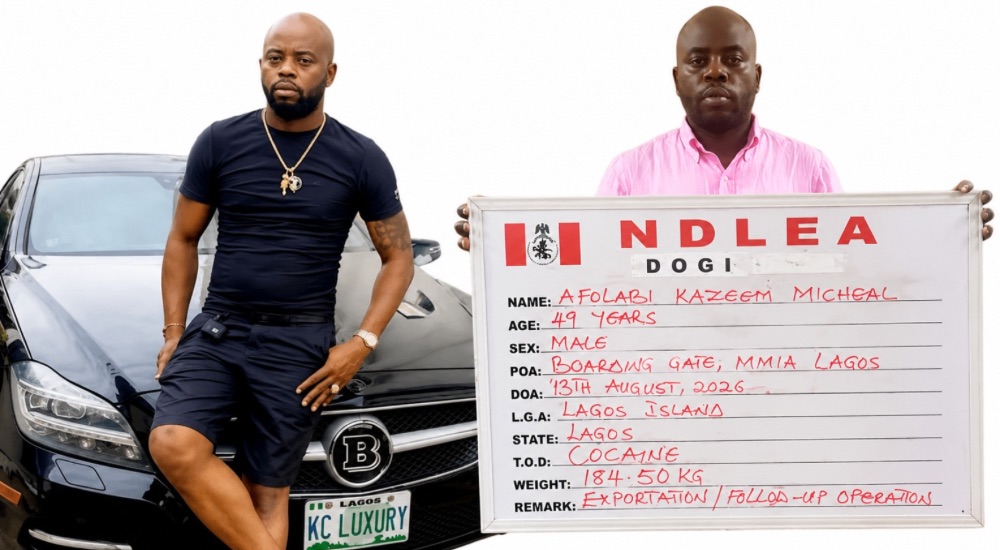
A Federal High Court in Lagos has dismissed an application by Afolabi Michael Kazeem seeking to overturn an order extending his detention for 30 days over his alleged involvement in the trafficking of 184.5 kilogrammes of cocaine.
The court held that the detention extension order granted on August 20, 2026, was properly issued and backed by the Constitution and relevant drug-control laws.
Kazeem, popularly known as KC Luxury, through his lawyer, Abdulakeem Labi-Lawal, SAN, had asked the court to set aside or strike out the order, arguing that the court lacked jurisdiction to extend his detention.
The lawyer contended that only a Magistrate Court could issue a remand order under Sections 293 to 299 of the Administration of Criminal Justice Act, 2015, describing the detention extension as an unlawful interference with the suspect’s constitutional right to personal liberty.
However, the National Drug Law Enforcement Agency (NDLEA), through its lawyer, Abu Ibrahim, dismissed the argument as a misconception of the nature of the order granted by the court.
Abu maintained that the August 20 order was not a remand order under the ACJA but an extension of detention granted to enable the relevant agency to conduct detailed investigations into the alleged drug-trafficking offence.
According to the ruling, Kazeem was arrested on August 13, 2026, at the departure hall of the Murtala Muhammed International Airport, Lagos, while allegedly attempting to travel to Paris, France.
The NDLEA had told the court that the suspect’s arrest followed the seizure of 184.5kg of cocaine at DHL in Ikeja, Lagos, with the agency alleging that Kazeem, popularly known as KC Luxury, was connected to the shipment.
Delivering judgment on the application on Thursday, Justice Aluko held that Sections 293 to 299 of the ACJA, which deal with remand proceedings, were not applicable to the case before the court.
The judge also held that the court has “exclusive” jurisdiction over drug-related matters by virtue of Section 251(1)(m) of the Constitution and Section 26(1) of the NDLEA Act.
The judge further held that the evidence presented by the NDLEA established reasonable suspicion of a drug-related offence, justifying the temporary deprivation of liberty under Section 35 of the Constitution.
Justice Aluko consequently dismissed KC Luxury’s application, holding that it constituted an abuse of court process and lacked merit.
I am a lawyer. I studied law and have remained in the practice of law in memory of my late mother, who paid for me to study law at Holborn Law Tutors in the UK. I eventually continued my legal education at the University of Ibadan and graduated from there. She paid almost £7,000 upfront for one year, which was the total tuition fee for one year at that private law school. I will be eternally grateful to her. May her soul continue to rest in perfect peace. We all know what the exchange rate would be today.
In her memory, I decided to remain in the practice of law throughout my legal practice and thereafter, even until now. I tried my hand at property marketing at one time, but I had to drop it, even though I made some money from it. I stopped because it was affecting my legal practice.
There is nothing you do, from my point of view, outside your profession that will not affect your profession. Politics is one of them. Politics itself is an art and a profession, but I must add that, if it is truly for the people and the betterment of the people, it is a good one.
One of the most respected politicians in this country was Chief Obafemi Awolowo, of blessed memory. He practised law and politics successfully, but he was more of a politician. He used his knowledge of law to better the lot of so many people during his lifetime, and, till today, his name remains a reference point in using politics to serve humanity.
Mahatma Gandhi was first a lawyer before he became a politician to serve his people. His name is known more in politics than in law.
Chief F.R.A. Williams was a politician until he dropped politics to devote his entire life to law. He was not a crossbreed. His pathological devotion to law can be seen and read in the political history of Nigeria. In legal practice, to which he committed his entire life after publicly renouncing politics, his invaluable impact is evident in law books, legal records and law reports. He was an enigma and an icon who will forever be remembered, like others too numerous to name, who stayed in the service of law.
The lawyer is meant to be the beacon of society. The lawyer’s creed is to ensure that society is governed according to the law. Chief Gani Fawehinmi was the people’s lawyer. He used the law to better the lot of society. His foray into politics was disastrous because the perception of the lawyer in practice and the lawyer in politics are not symbiotic. They are strange bedfellows.
The people may hail the lawyer in law, but not the lawyer in politics. The ingredients you add to the soup that make a lawyer are different from the ingredients you add to the soup that make a politician. Femi Falana, SAN, my dear friend, was in the same boat as the late Chief Gani Fawehinmi. I feel him more in law now than when he did both.
A lawyer is known to keep to his or her word. Robert Traver, in his book The Anatomy of Murder, stated thus:
“That’s what makes the practice of law, like prostitution, one of the last of the unpredictable professions—both employ the seductive arts, both try to display their wares to best advantage and both must pretend enthusiastically to woo total strangers.”
Joseph Story lived from 1779 to 1845. He was an American lawyer, politician and jurist who served as an Associate Justice of the United States Supreme Court from 1812 until his death in 1845. He stated thus:
“I will not say….that ‘The law will admit of no rival’, but I will say that it is a jealous mistress, and requires a long and constant courtship. It is not to be won by trifling favours…”
Henry David Thoreau (1817–1862) was not a lawyer. He was an American essayist, poet and philosopher. He said:
“The lawyer’s truth is not Truth, but consistency, or a consistent expediency. Truth is always in harmony with herself, and is not concerned chiefly to reveal the justice that may consist with wrongdoing.”
I have gone through the lawyer’s creed, which is to uphold the rule of law, personal dignity and independence; to offer faithfulness, competence, diligence and good judgment while providing vigorous and honest representation without sacrificing professional ethics; to practise with fairness, integrity and civility, avoiding malicious tactics, unnecessary delays or abusive discovery; to show profound respect, candour and courtesy, ensuring that the search for truth and justice remains uncompromised; to the court or tribunal; to make justice accessible to the poor; and to protect the legal profession as a noble calling rather than a mere business.
I have gone this far in order to buttress the topic for discussion. The practice of law and politics can never converge. You cannot be a master of both. You can be successful in both, no doubt, but along the way, there are sacrifices that will most likely be at cross-purposes with the law.
Very few lawyers, like Chief F.R.A. Williams, of blessed memory, have sacrificed politics for law. The political lawyer will criticise anything, even when the law is clear that, without evidence, you are not expected to speculate.
Nowadays, many lawyers in politics take to the airwaves and the print media, especially in this era of social media, to generalise when making statements. How can a lawyer, trained in the practice of law, make general statements on any topic, especially these days when the judiciary, even in retirement, has become a topic for discussion without any evidence? How can people make general statements about Senior Advocates of Nigeria or lawyers generally?
It is pathetic that those who ought to know, by virtue of their level of education, professional qualifications and recognition in the legal community, are more guilty of this. How can a lawyer remain silent even when injustice happens in front of him and behind him, too, but he keeps quiet?
Many keep quiet these days because they want to satisfy their paymasters, even when it is glaring that the legal profession is suffering from their silence and/or complicity and complacency. These days, many voice personal opinions without let or hindrance for personal and political reasons. Some attack their professional colleagues, even the judiciary, when they cannot get what they want, but they must vent their anger on someone. Some are paid to attack or bring down their fellow colleagues, whether at the Bar or on the Bench.
I like the Yoruba language a lot. I am sorry I will not be able to interpret the idioms I will use:
“Tó bá máa jẹ Oshakala, jẹ Oshakala; tó bá máa jẹ Oshokolo, jẹ Oshokolo. Oshakala, Oshokolo kò yẹ ọmọ ènìyàn.”
“Arítení mo ń wí, àfi àpáàdì bó tiẹ̀ mọ́lẹ̀.”
“Kò sí ẹni tí a máa sí idi ẹ̀, tí a kò ní bá ẹ̀ẹ̀pà níbẹ̀.”
Apologies to those who will read this who are not Yoruba, or those who are Yoruba but do not understand these idioms.
To those who criticise, not out of holiness per se, not out of being a “straight” lawyer or simply out of a desire to be fair, but generalise in order to look good or elicit unmerited applause, look in the mirror and think back to whether you have not done anything you accuse others of doing.
In writing or criticising generally, come out, but most importantly, PRACTISE WHAT YOU PREACH BEFORE YOU CRITICISE.



Alleged $6b Mambilla Power Contract: Tinubu Hails EFCC for FG’s Victory at Arbitration Tribunal

EFCC Hands Over Recovered N140m to Loan Firm in Lagos

COPSUN Applauds EFCC on NELFUND
Nigerian nurses stage seven‑day warning strike over pay, staffing

Dangote Refinery to deploy 4,000 gas‑powered trucks for distribution

Nigeria approves plan to refinance ₦4tn power-sector debt
-
Energy1 year ago
Dangote Refinery to deploy 4,000 gas‑powered trucks for distribution
-
Health1 year ago
Nigerian nurses stage seven‑day warning strike over pay, staffing
-
Economy1 year ago
Nigeria approves plan to refinance ₦4tn power-sector debt
-
 Education1 year ago
JAMB sets 2025/26 university cut‑off at 150, bars under‑16
-
 Entertainment1 year ago
Sean Kingston sentenced to 3½ years in prison over $1 million fraud
-
 Crime & Justice7 months ago
BREAKING: Two Chinese Directors Jailed 46 Years Each Over ₦3.4bn, $2.5m Crypto Fraud in Lagos
-

 Business7 months ago
Nigeria Revenue Service Collects ₦28.3trn in 2025, Sets ₦40.7trn Target for 2026
-

 Crime & Justice8 months ago
Police Arrest 24-Year-Old Over ₦48.5m Romance Fraud in Lagos