
EFCC
EU Strengthens Collaboration with EFCC

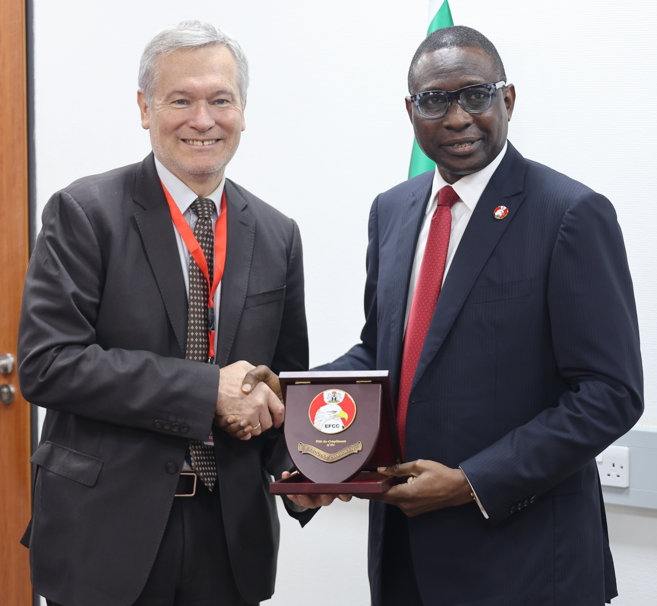
The European Union (EU) has reaffirmed its commitment to strengthening its partnership with the Economic and Financial Crimes Commission (EFCC), particularly in the areas of anti-corruption, cybercrime, training, and financial crime investigation and prosecution.
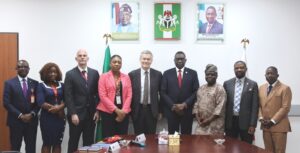
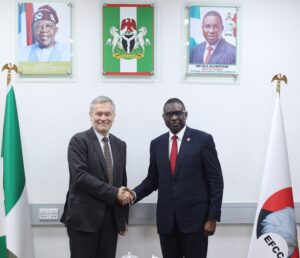
EU Ambassador to Nigeria, Gautier Mignot, stated this in Abuja on Tuesday, July 28, 2026, when he led a delegation on a courtesy visit to the corporate headquarters of the EFCC.
Stressing the strategic importance of the EFCC and the basis for the partnership with the Commission, he stated:
“The role of the EFCC is so important for us, both for the stability and prosperity of Nigeria and for our partnership, to be able to tell our potential investors: ‘You can safely come to Nigeria. There is a compliant business environment because you have strong institutions like the EFCC to make sure that this is the place.'”
Mignot expressed satisfaction with the longstanding partnership between the EU and the EFCC, which he said had existed since the establishment of the Commission, noting that the relationship had continued over the years, particularly through the Rule of Law and Anti-Corruption (RoLAC) Programme.
He assured that the EU remained committed to continuing the partnership and supporting efforts to strengthen the institutional capacity of the EFCC, improve investigative effectiveness, and enhance prosecution.
“We are very much committed to continuing this partnership, doing whatever we can do to strengthen the institution, improve investigative effectiveness, and prosecution,” he said.
He further stressed that the EU had ongoing initiatives aimed at supporting the fight against cybercrime, describing the issue as a priority for the EFCC in view of its growing prevalence. To further strengthen this effort, he disclosed that the EU had proposed training for EFCC personnel on the Cybercrime Response Centre, with the modalities of the training still being worked out.
He added that the EU was also strengthening its support for Anti-Money Laundering and Countering the Financing of Terrorism (AML/CFT) compliance while congratulating the EFCC on its efforts in the fight against corruption and cybercrime.
He said the visit was taking place at a very important moment in the EU-Nigeria partnership, stressing that the EU, alongside its 14 member states, remains a major trading, investment, and development partner of Nigeria.
According to him, the EU is committed to deepening its partnership with Africa and leveraging greater private investment, particularly by mobilizing European companies to partner with Nigerian businesses to develop local manufacturing value chains and other sectors, including agriculture.
“Governance issues remain a core priority for us, also as an enabler for investment and for the operations of EU companies,” he said.
The Ambassador noted that European companies are particularly attentive to the business environment and compliance issues, stressing that the role of the EFCC is therefore important to the stability and prosperity of Nigeria, as well as to the EU-Nigeria partnership. He expressed optimism that the existence of strong institutions such as the EFCC would give potential European investors confidence to do business in Nigeria.
Responding, the Executive Chairman of the EFCC, Mr. Ola Olukoyede, described the Commission as Nigeria’s foremost anti-corruption agency, responsible for coordinating the investigation and prosecution of financial crimes in the country.
Olukoyede said the Commission had, over the years, continued to work towards ridding the country of economic and financial crimes, noting that it had recently recorded significant progress in the fight against cybercrime and terrorism financing.
“Over the years, we have strived to ensure that the country is rid of economic and financial crimes. Recently, we recorded a modest achievement in the fight against cybercrime and terrorism financing. We were taken off the grey list of the Financial Action Task Force (FATF), and we are looking forward to doing more,” he said.
The EFCC Chairman recalled that while appearing before the National Assembly during his screening and confirmation process, he had assured Nigerians that he would use his position and the instrumentality of the anti-corruption fight to stimulate the economy and attract investment into the country.
He said the Commission’s anti-corruption mandate was not only about investigating and prosecuting financial crimes but also about creating an environment where legitimate businesses and investments could thrive.
Olukoyede explained that the proposed Cybercrime Response Centre was part of efforts to protect investments and strengthen the country’s response to cybercrime.
He said the Centre, when fully operational, would operate 24 hours a day, seven days a week, with the capacity to respond to reports in real time, gather intelligence, process petitions, and act on relevant information.
“The essence of the Centre is to handle real-time reports, gather intelligence, respond to petitions, process information, and all of that,” he said.
Olukoyede assured the EU Ambassador and European countries of the Commission’s readiness to support legitimate investors and protect the business environment from the threats posed by economic and financial crimes.
“Rest assured that we are here to support all EU countries, particularly their investors,” he said.
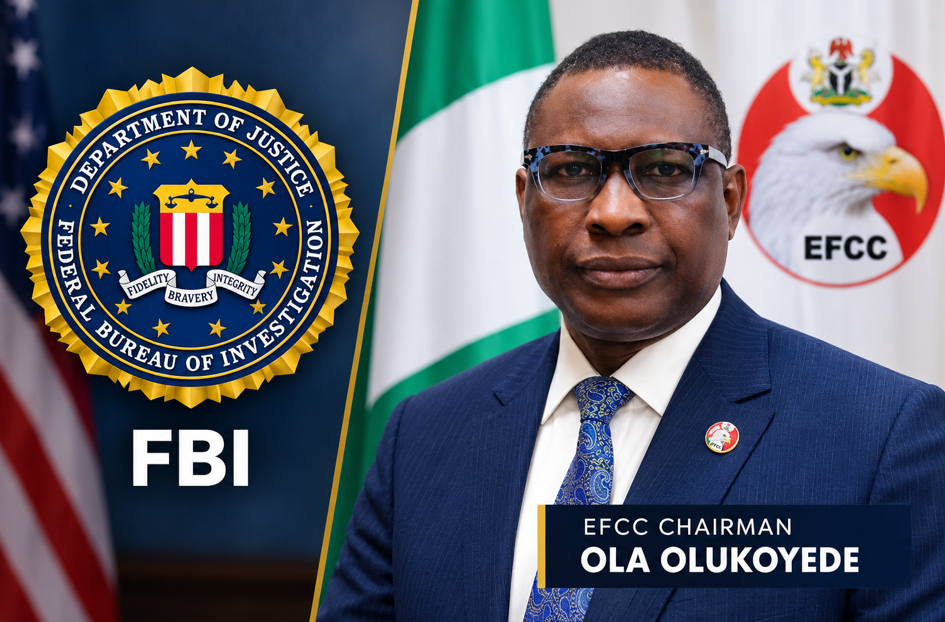
The Federal Bureau of Investigation (FBI) has commended the Executive Chairman of the Economic and Financial Crimes Commission (EFCC), Ola Olukoyede, and the Commission for their efforts and vital role in Operation Artemis, a joint international effort to disrupt financially motivated sextortion networks targeting minors.
The commendation was conveyed in a letter signed by FBI Director Kash Patel, who praised the Commission for its collaboration with the Bureau in the arrest and extradition of suspects facing federal charges in the United States.
In the letter addressed to Olukoyede, Patel acknowledged the Commission’s contribution to the operation, stating that “the Economic and Financial Crimes Commission, EFCC, has played a vital role in Operation Artemis, a joint effort focused on disrupting financially motivated sextortion rings targeting juveniles.”
He said that, under Olukoyede’s leadership, the EFCC designated personnel to support the investigations and facilitate the transfer of suspects from Nigeria to face prosecution in the United States.
Specifically, the FBI Director commended the EFCC for apprehending Adebola Festus Adekunle and Mudashiru Afeez Olawale, who were indicted in the United States in 2023 over allegations relating to the sexual exploitation and extortion of minors.
The two suspects were extradited to the United States in August 2026, with the EFCC facilitating the process following investigations and extradition proceedings. They are facing federal charges relating to sexual exploitation in cases involving the deaths of minors.
Patel noted that the successful outcome of the cases would not have been possible without the EFCC’s assistance and commitment to international law enforcement cooperation.
“The successful outcome of these cases would not have been possible without your assistance and dedication to international law enforcement collaboration,” he said.
The FBI Director further expressed appreciation to Olukoyede and the Commission for their commitment to justice and continued cooperation, while expressing optimism about strengthening the partnership between both agencies.
“Please accept my sincere appreciation for your commitment to justice and steadfast cooperation. I look forward to the continued partnership with the EFCC,” he stated in the letter.
The extradition of Adekunle and Olawale followed FBI investigations into separate sextortion schemes targeting male minors in the United States. The investigations linked the alleged activities to two teenage victims who died by suicide after being subjected to online sexual exploitation and extortion.
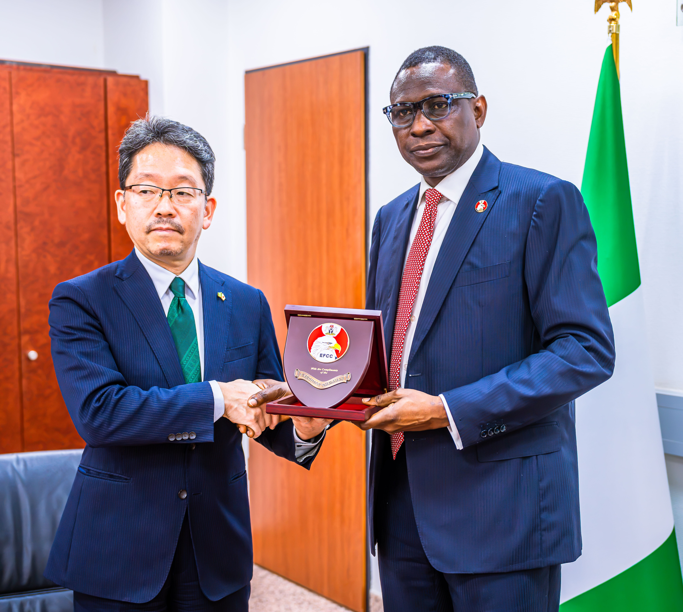
The Japanese Ambassador-Designate to Nigeria, His Excellency, Hideo Suzuki Paid a Courtesy Visit to the Executive Chairman of the Economic and Financial Crimes Commission, EFCC, Mr. Ola Olukoyede in his office today, October 28, 2026. He was accompanied on the visit by First Secretary, Security, Yuji Murakami and Senior Information Analyst, Dogara Ankut.

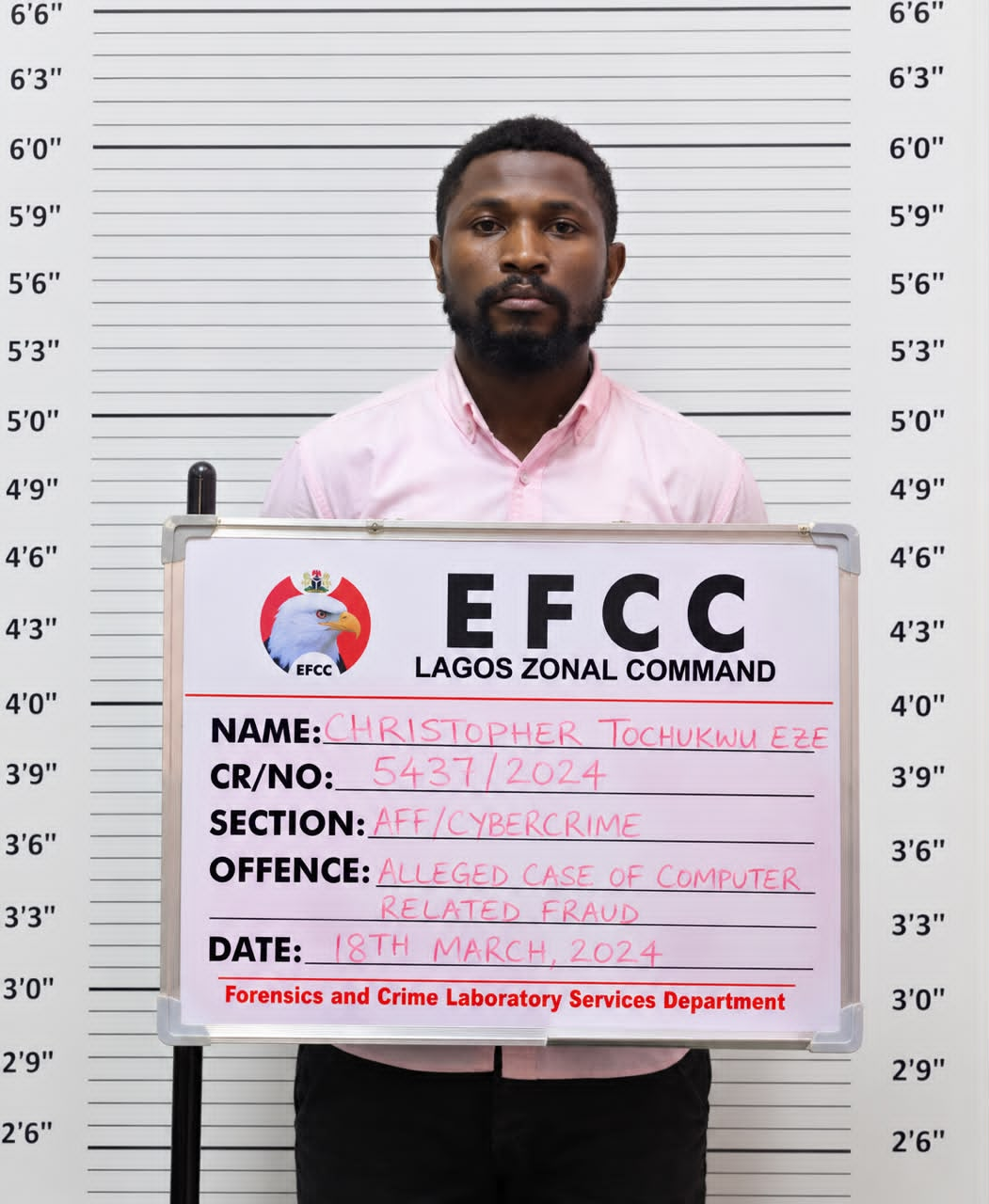
Justice O. O. Abike-Fadipe of the Special Offences Court sitting in Ikeja, Lagos, on Tuesday, October 27, 2026, sentenced a former banker, Christopher Jackson Edeh, to a total of 39 years’ imprisonment for his involvement in a ₦2.7 billion fraud prosecuted by the Lagos Zonal Directorate 1 of the Economic and Financial Crimes Commission (EFCC).
Edeh, who was arraigned on February 28, 2024, faced nine counts bordering on fraudulent false accounting and unauthorised access to a computer system.
The charges alleged that he altered the bank account details of several customers and government-related entities, including the Kano State Government Power Intervention Fund, NNPC Trading Limited, Stallion Vision Ltd, the Lagos State Government Blue Line, the State Contributory Pension Account and Chukwuemeka Odumegwu Ojukwu University, with intent to defraud.
During the trial, prosecuting counsel, Z. B. Atiku, called three witnesses and tendered several documents in evidence to establish the case against the defendant. The defence, in turn, called one witness.
In her judgment, Justice Abike-Fadipe held that the prosecution had proved its case beyond reasonable doubt and consequently convicted Edeh on all nine counts.
The court sentenced him to five years’ imprisonment without an option of fine on each of counts one to seven, bordering on fraudulent false accounting, and two years’ imprisonment without an option of fine on each of counts eight and nine, relating to unauthorised access to a computer system with intent to facilitate the commission of crimes.
The court ordered that all the sentences run concurrently.



FBI Commends Olukoyede, EFCC for Support in Tackling Sextortion, Cybercrime

EFCC Photo News

Alleged ₦76bn, $31.5m Fraud: Witness Says Kuru Approved Arik Air Receivership Without Prior AMCON Board Approval

Alleged ₦1.4bn Oil Fraud: EFCC Re-Arraigns Nadabo Energy Boss, Ali Peters, Firm in Lagos

Alleged ₦1.06bn Fraud: EFCC Secures Court Order to Freeze Suspect’s Account

Again, Dangote Refinery Hikes Petrol To ₦1,175/Litre, Diesel To ₦1,620/Litre — Report
-
 EFCC7 months ago
Alleged ₦1.4bn Oil Fraud: EFCC Re-Arraigns Nadabo Energy Boss, Ali Peters, Firm in Lagos
-
 EFCC1 week ago
Alleged ₦1.06bn Fraud: EFCC Secures Court Order to Freeze Suspect’s Account
-
 News8 months ago
Again, Dangote Refinery Hikes Petrol To ₦1,175/Litre, Diesel To ₦1,620/Litre — Report
-
 News9 months ago
Senate Retains Two-Year Jail Term for PVC Trading, Raises Fine to ₦5m
-

 EFCC8 months ago
Lagos Court Jails Man 18 Months for Defrauding Sterling Bank of ₦30m
-
EFCC4 weeks ago
EFCC Hands Over Recovered ₦107m to Property Fraud Victim in Lagos
-

 Economy8 months ago
Naira Rebounds To ₦1,363.5/$
-

 Economy8 months ago
Naira Closes in the Red at ₦1,341.35/$