
EFCC
EFCC, NFIU Prepare for 2027 FATF’s Mutual Evaluation of Nigeria


The Economic and Financial Crimes Commission, EFCC and the Nigerian Financial Intelligence Unit, NFIU, have commenced a three-day stocktake to assess the country’s preparedness for the Mutual Evaluation Exercise of the Financial Action Task Force, FATF, on anti-money laundering and counter-terrorist financing , scheduled to take place in 2027.
The stocktake, which began on Tuesday, September 29, 2026, at the EFCC’ corporate Headquarters in Abuja, will continue on Wednesday, September 30, and October 2, 2026.
The exercise will bring together officials of both agencies and relevant stakeholders to review progress, identify gaps and strengthen inter-agency cooperation ahead of the mutual evaluation.
In his opening remarks, EFCC’s Executive Chairman, Ola Olukoyede, disclosed that the stocktake was a demonstration of the country’s commitment to meeting international standards on anti-money laundering and counter-terrorist financing.
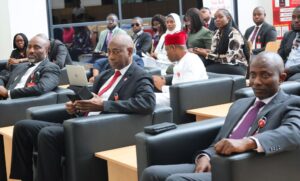
Represented by the Secretary to the Commission, Muhammad Hassan Hammajoda, Olukoyede stated that, “This event is a demonstration of our shared commitment to achieving full compliance with the anti-money laundering thresholds, stipulated by the FATF, in strengthening Nigeria’s Anti-Money Laundering, Countering the Financing of Terrorism/Counter Proliferation Financing Framework.”
For non-compliance with FATF’s AML/CFT/CPFF regulations, the global watchdog in 2022, classified Nigeria among the countries requiring its enhanced monitoring, designated as Grey List. With improved compliance with AML/CFT/CPFF frameworks FATF, provisionally removed Nigeria from its Grey List on October 24, 2025. Grey listing comes with a variety of untoward consequences on the countries so listed. As a result, Olukoyede called for all hands to be on deck to avoid the country’s return to the FATF Grey List.
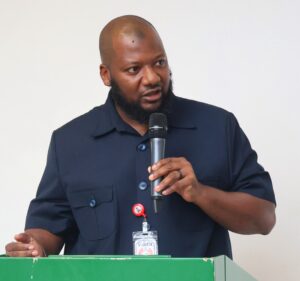
“It is unimaginable that Nigeria returns to the Grey List. Issues for consideration today include use of financial intelligence, asset tracing, recovery and management, money laundering, investigation and prosecution,” he said.
Olukoyede described the stocktake as an exercise that would provide an opportunity for the country to demonstrate the progress it has made since its removal from the FATF Grey List and consolidate at the end of the Mutual Evaluation.
“Fundamentally, this exercise offers us an opportunity to retrospect and determine what is working at residual cost therein to enable us to redirect resources as appropriate at the end of the Mutual Evaluation exercise,” he said, adding that the Commission remained committed to strengthening Nigeria’s financial system and sustaining its anti-money laundering efforts.
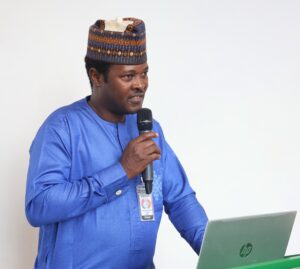
“Since Nigeria was removed from the FATF Grey List, we have scaled up our Anti-Money Laundering enforcement activities, recovering of proceeds of crimes, (Recovery and Management Act 2022),” he said.
Also speaking, the Chief Executive Officer of the NFIU, Mrs Hafsat Abubakar Bakari, stated that stocktake was important because of the longstanding relationship between the two institutions and the need to strengthen the country’s collective response to financial crimes.
Bakari, who was represented by the Chief Operating Officer, Law Enforcement Agencies, Emmanuel Sotande, stated that the stocktake exercise was not about addressing a crisis but about identifying areas where both agencies could improve on their collective performance ahead of the Mutual Evaluation.
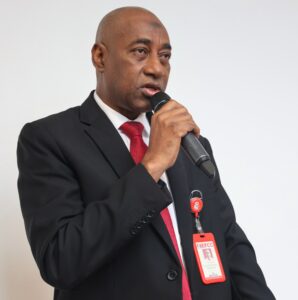
According to Bakari, “We gathered here not because there is a problem to solve, but because there is a standard to uphold. Therefore, this exercise provides an opportunity to honestly reflect. It allows us to identify what is working, to also understand where challenges remain and to agree on a particular action required to strengthen our preparedness.”
She stressed that the Mutual Evaluation would go beyond assessing Nigeria’s laws and institutional structures to examining how effectively the country implements them.
“The reality is that international assessors will not only look at our laws, frameworks and structure, they will look at the evidence that we are able to put in place to produce desirable outcomes. They will look for examples of effective investigation, successful prosecutions, asset recovery, inter-agency collaboration and intelligence use to distort criminal activities. Fortunately, these are areas the EFCC has played a central role in shaping Nigeria’s progress in the last year,” she said.
In his presentation, Bakari’s Chief of Staff, Mohammed Shahid Ahmed, outlined key areas Nigeria must address ahead of the 2027 FATF’s Mutual Evaluation.
He recalled that Nigeria’s 2019 Mutual Evaluation, whose report was published in 2021, identified deficiencies that led to the country’s placement on the FATF Grey List. He said the country subsequently implemented measures to address the deficiencies, particularly in financial investigations, identification and recovery of proceeds of crime, international cooperation and cross-border currency declaration, leading to Nigeria’s removal from the Grey List on October 24, 2025.
Ahmed, however, regretted that the country had just little time to consolidate on the gains of the removal, as preparations for the next Mutual Evaluation commenced barely a year after Nigeria’s removal from the Grey List.
He disclosed that the assessment would focus not only on technical compliance with FATF standards but also on effectiveness, including whether the agencies were using financial intelligence, prioritised investigations based on identified risks and demonstrated that their enforcement efforts were producing decisive results.
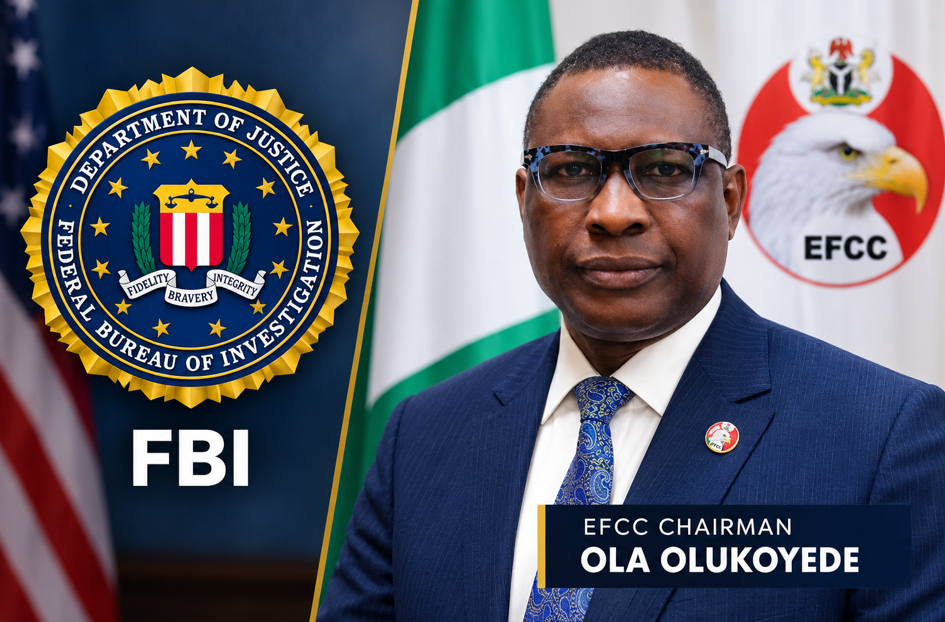
The Federal Bureau of Investigation (FBI) has commended the Executive Chairman of the Economic and Financial Crimes Commission (EFCC), Ola Olukoyede, and the Commission for their efforts and vital role in Operation Artemis, a joint international effort to disrupt financially motivated sextortion networks targeting minors.
The commendation was conveyed in a letter signed by FBI Director Kash Patel, who praised the Commission for its collaboration with the Bureau in the arrest and extradition of suspects facing federal charges in the United States.
In the letter addressed to Olukoyede, Patel acknowledged the Commission’s contribution to the operation, stating that “the Economic and Financial Crimes Commission, EFCC, has played a vital role in Operation Artemis, a joint effort focused on disrupting financially motivated sextortion rings targeting juveniles.”
He said that, under Olukoyede’s leadership, the EFCC designated personnel to support the investigations and facilitate the transfer of suspects from Nigeria to face prosecution in the United States.
Specifically, the FBI Director commended the EFCC for apprehending Adebola Festus Adekunle and Mudashiru Afeez Olawale, who were indicted in the United States in 2023 over allegations relating to the sexual exploitation and extortion of minors.
The two suspects were extradited to the United States in August 2026, with the EFCC facilitating the process following investigations and extradition proceedings. They are facing federal charges relating to sexual exploitation in cases involving the deaths of minors.
Patel noted that the successful outcome of the cases would not have been possible without the EFCC’s assistance and commitment to international law enforcement cooperation.
“The successful outcome of these cases would not have been possible without your assistance and dedication to international law enforcement collaboration,” he said.
The FBI Director further expressed appreciation to Olukoyede and the Commission for their commitment to justice and continued cooperation, while expressing optimism about strengthening the partnership between both agencies.
“Please accept my sincere appreciation for your commitment to justice and steadfast cooperation. I look forward to the continued partnership with the EFCC,” he stated in the letter.
The extradition of Adekunle and Olawale followed FBI investigations into separate sextortion schemes targeting male minors in the United States. The investigations linked the alleged activities to two teenage victims who died by suicide after being subjected to online sexual exploitation and extortion.
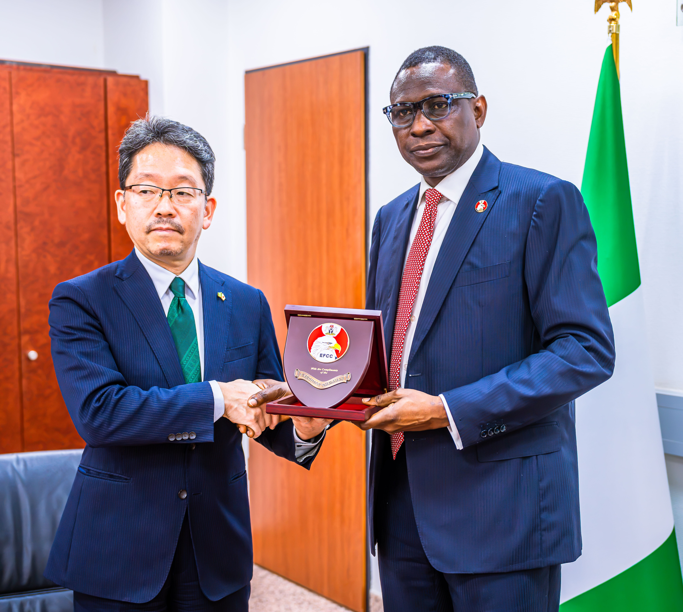
The Japanese Ambassador-Designate to Nigeria, His Excellency, Hideo Suzuki Paid a Courtesy Visit to the Executive Chairman of the Economic and Financial Crimes Commission, EFCC, Mr. Ola Olukoyede in his office today, October 28, 2026. He was accompanied on the visit by First Secretary, Security, Yuji Murakami and Senior Information Analyst, Dogara Ankut.
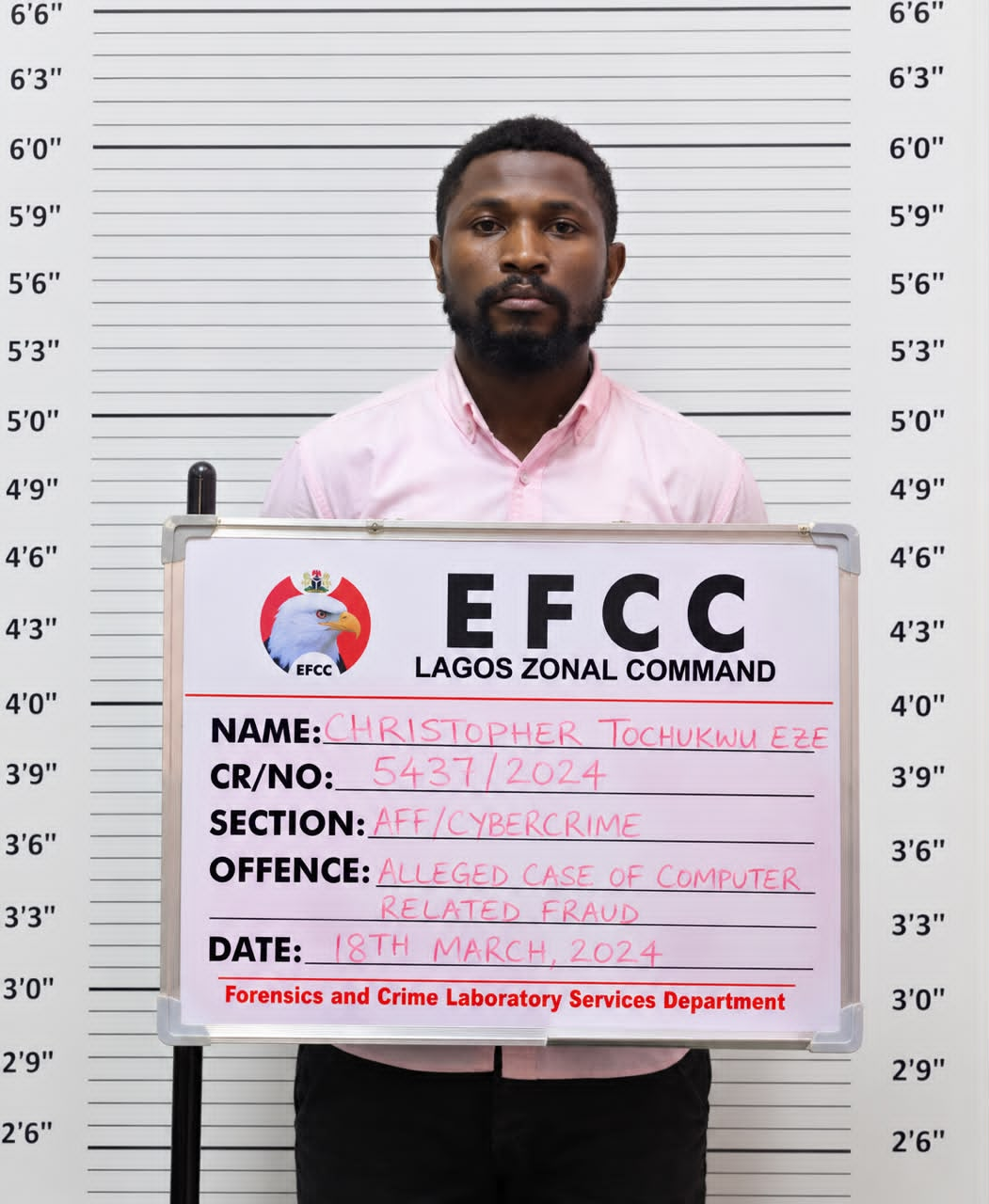
Justice O. O. Abike-Fadipe of the Special Offences Court sitting in Ikeja, Lagos, on Tuesday, October 27, 2026, sentenced a former banker, Christopher Jackson Edeh, to a total of 39 years’ imprisonment for his involvement in a ₦2.7 billion fraud prosecuted by the Lagos Zonal Directorate 1 of the Economic and Financial Crimes Commission (EFCC).
Edeh, who was arraigned on February 28, 2024, faced nine counts bordering on fraudulent false accounting and unauthorised access to a computer system.
The charges alleged that he altered the bank account details of several customers and government-related entities, including the Kano State Government Power Intervention Fund, NNPC Trading Limited, Stallion Vision Ltd, the Lagos State Government Blue Line, the State Contributory Pension Account and Chukwuemeka Odumegwu Ojukwu University, with intent to defraud.
During the trial, prosecuting counsel, Z. B. Atiku, called three witnesses and tendered several documents in evidence to establish the case against the defendant. The defence, in turn, called one witness.
In her judgment, Justice Abike-Fadipe held that the prosecution had proved its case beyond reasonable doubt and consequently convicted Edeh on all nine counts.
The court sentenced him to five years’ imprisonment without an option of fine on each of counts one to seven, bordering on fraudulent false accounting, and two years’ imprisonment without an option of fine on each of counts eight and nine, relating to unauthorised access to a computer system with intent to facilitate the commission of crimes.
The court ordered that all the sentences run concurrently.



FBI Commends Olukoyede, EFCC for Support in Tackling Sextortion, Cybercrime

EFCC Photo News

Alleged ₦76bn, $31.5m Fraud: Witness Says Kuru Approved Arik Air Receivership Without Prior AMCON Board Approval

Alleged ₦1.4bn Oil Fraud: EFCC Re-Arraigns Nadabo Energy Boss, Ali Peters, Firm in Lagos

Alleged ₦1.06bn Fraud: EFCC Secures Court Order to Freeze Suspect’s Account

Again, Dangote Refinery Hikes Petrol To ₦1,175/Litre, Diesel To ₦1,620/Litre — Report
-
 EFCC7 months ago
Alleged ₦1.4bn Oil Fraud: EFCC Re-Arraigns Nadabo Energy Boss, Ali Peters, Firm in Lagos
-
 EFCC2 weeks ago
Alleged ₦1.06bn Fraud: EFCC Secures Court Order to Freeze Suspect’s Account
-
 News8 months ago
Again, Dangote Refinery Hikes Petrol To ₦1,175/Litre, Diesel To ₦1,620/Litre — Report
-
 News9 months ago
Senate Retains Two-Year Jail Term for PVC Trading, Raises Fine to ₦5m
-
EFCC4 weeks ago
EFCC Hands Over Recovered ₦107m to Property Fraud Victim in Lagos
-

 EFCC8 months ago
Lagos Court Jails Man 18 Months for Defrauding Sterling Bank of ₦30m
-

 Economy8 months ago
Naira Rebounds To ₦1,363.5/$
-

 Economy8 months ago
Naira Closes in the Red at ₦1,341.35/$