
EFCC
EFCC, CAC Join Forces Against Unregistered POS Operators


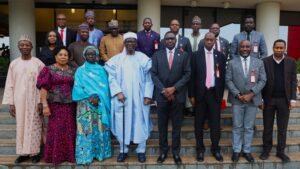
The Economic and Financial Crimes Commission (EFCC) and the Corporate Affairs Commission (CAC) have expressed concerns over the risks posed to businesses and national security by the activities of unregistered Point of Sale (POS) operators.
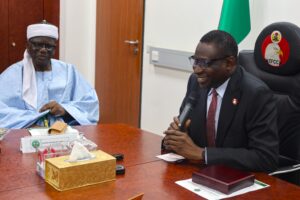
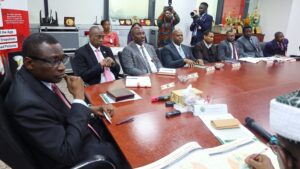
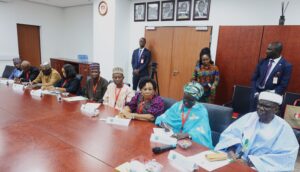
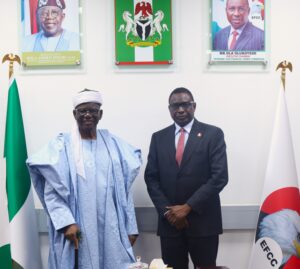
The concerns were expressed in Abuja on Thursday, June 25, 2026, when the Chairman of the CAC Board, Senator Ibrahim Adah, paid a courtesy visit to the Executive Chairman of the EFCC, Mr. Ola Olukoyede, at the corporate headquarters of the Commission.
Adah, who was accompanied by some management staff of the CAC, sought the EFCC’s support in enforcing compliance among POS operators nationwide, disclosing that:
“Presently, only about 20% of POS operators are registered with the CAC, a situation inconsistent with the Companies and Allied Matters Act (CAMA) 2020 and the Central Bank of Nigeria’s Agent Banking Regulations 2026, which require all businesses operating under a business name to be duly registered.
“Furthermore, Mr. Chairman, we seek closer cooperation in developing a reliable database of POS operators for use by the EFCC and other law enforcement agencies.”
He warned that evidence increasingly suggests that criminal proceeds, including ransom payments linked to kidnapping cases, are sometimes routed through POS terminals.
Adah also said that his visit was aimed at engaging public institutions that maintain close working relationships with the Commission and applauded the EFCC for its role in the fight against economic and financial crimes.
He stressed that both institutions have interconnected mandates, explaining that while the CAC registers and regulates companies in Nigeria, the EFCC investigates and prosecutes financial crimes.
Decrying the misuse of some corporate entities for fraudulent activities, he stated:
“When companies are misused for fraud or money laundering, the mandates of both institutions are directly affected. Neither of the two agencies can fight and win the war against economic and financial crimes, especially those perpetrated through corporate entities, if we work alone. Collaboration is required in that regard. A strong CAC registry makes the work of the EFCC easier, just as strong EFCC enforcement protects the integrity of the CAC corporate registry.”
According to him, stronger synergy between the two agencies requires a focus on data and intelligence sharing on fraudulent companies, public sensitisation on financial risks, and capacity building for staff.
He therefore expressed the CAC’s commitment to partnering with the EFCC to deepen corporate compliance and protect the financial system.
“The CAC Board is fully committed to this partnership. We see the EFCC as a serious and strategic partner in this drive to deepen corporate compliance, promote transparency, and safeguard the integrity of Nigeria’s financial system,” he said.
In response, Olukoyede also expressed concerns about POS operators, describing their activities as a major challenge to the nation’s financial system.
“If you do not regulate the activities of such key players, you will be having major problems and challenges within your financial ecosystem,” he said.
He reaffirmed the Commission’s commitment to working closely with the CAC in combating economic crimes and promoting regulatory compliance.
The EFCC chairman described the CAC as the “gateway to economic growth in Nigeria because the first point of contact for foreign investors in Nigeria is the Corporate Affairs Commission.”
He disclosed that the EFCC had established a dedicated desk to handle matters involving the CAC, while revealing that ongoing investigations involving about 200 companies had yielded considerable results.
“As a matter of fact, I think we have about 200 companies from the list you forwarded to us that we are currently investigating, and we have made reasonable progress in those investigations. We have made very interesting discoveries, which will assist you by the time you receive the report. We will continue to work together to ensure regulatory compliance among the companies you regulate.”
He noted that most public corruption cases investigated by the EFCC involve procurement and contract fraud carried out through companies regulated by the CAC.
He also stressed the need for both agencies to address internal control weaknesses and strengthen accountability mechanisms.
On data sharing and intelligence exchange, Olukoyede directed officials of both agencies to review and update an existing Memorandum of Understanding (MoU) to reflect current realities, especially in the areas of beneficial ownership information and data protection.
VIEW MORE PHOTOS:
The Economic and Financial Crimes Commission (EFCC) views with grave concern the misrepresentation of the reaction of its counsel, Larry Peters Aso, to the judgment delivered by Justice Suleiman Belgore of the Federal Capital Territory (FCT) High Court in a fundamental rights enforcement suit filed by legal practitioner Dr Ted Iseghoi-Edwards.
The judge reportedly cleared Iseghoi-Edwards of alleged fraud relating to services rendered to the nation’s 774 local government councils. He also disagreed with the EFCC’s position regarding its investigation report on the London-Paris Club refunds.
Reacting to the judgment, Aso thanked the judge for his industry in attending to the matter and stated that the EFCC would apply for a Certified True Copy (CTC) of the judgment “and study it to know the necessary steps to take.”
He did not make any statement about an EFCC report from 2024 concerning allegations that Iseghoi-Edwards “fraudulently obtained the judgments, because he instituted proceedings against the Federal Government in the United States.”
Additionally, claims that Aso said the report was prepared under pressure from higher authorities “after Iseghoi-Edwards assigned his promissory notes to third parties in the United States, where they threatened to sue the Federal Government” are entirely mischievous and amount to deliberate character assassination.
This framing was intended to insinuate that extraneous influences affected the matter, which was not the case.
The record of proceedings from Tuesday, October 20, 2026, when the judgment was delivered, can be accessed to verify Aso’s reaction.
The Commission urges the media to be more objective in reporting court proceedings in the interest of justice.
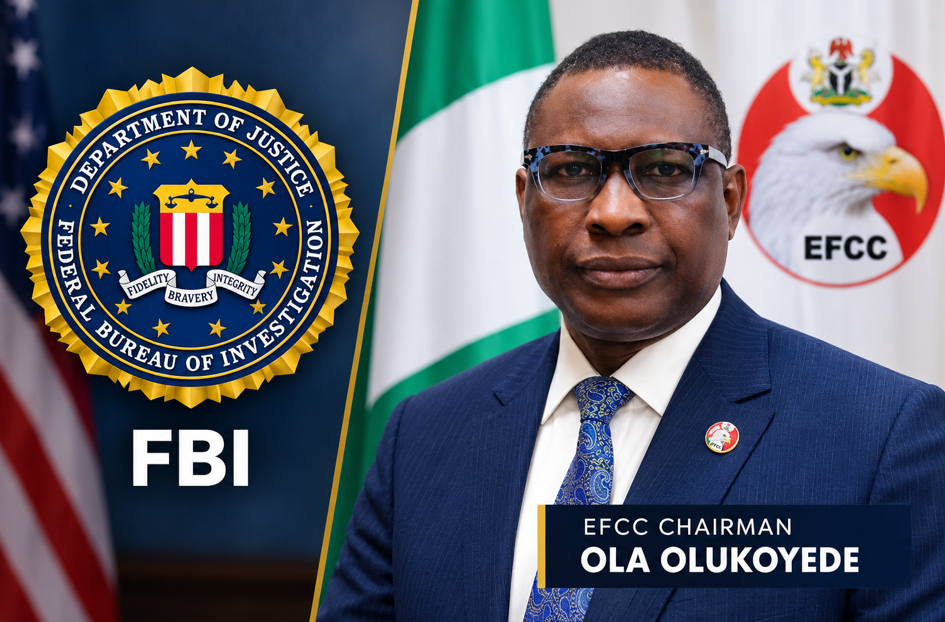
The Federal Bureau of Investigation (FBI) has commended the Executive Chairman of the Economic and Financial Crimes Commission (EFCC), Ola Olukoyede, and the Commission for their efforts and vital role in Operation Artemis, a joint international effort to disrupt financially motivated sextortion networks targeting minors.
The commendation was conveyed in a letter signed by FBI Director Kash Patel, who praised the Commission for its collaboration with the Bureau in the arrest and extradition of suspects facing federal charges in the United States.
In the letter addressed to Olukoyede, Patel acknowledged the Commission’s contribution to the operation, stating that “the Economic and Financial Crimes Commission, EFCC, has played a vital role in Operation Artemis, a joint effort focused on disrupting financially motivated sextortion rings targeting juveniles.”
He said that, under Olukoyede’s leadership, the EFCC designated personnel to support the investigations and facilitate the transfer of suspects from Nigeria to face prosecution in the United States.
Specifically, the FBI Director commended the EFCC for apprehending Adebola Festus Adekunle and Mudashiru Afeez Olawale, who were indicted in the United States in 2023 over allegations relating to the sexual exploitation and extortion of minors.
The two suspects were extradited to the United States in August 2026, with the EFCC facilitating the process following investigations and extradition proceedings. They are facing federal charges relating to sexual exploitation in cases involving the deaths of minors.
Patel noted that the successful outcome of the cases would not have been possible without the EFCC’s assistance and commitment to international law enforcement cooperation.
“The successful outcome of these cases would not have been possible without your assistance and dedication to international law enforcement collaboration,” he said.
The FBI Director further expressed appreciation to Olukoyede and the Commission for their commitment to justice and continued cooperation, while expressing optimism about strengthening the partnership between both agencies.
“Please accept my sincere appreciation for your commitment to justice and steadfast cooperation. I look forward to the continued partnership with the EFCC,” he stated in the letter.
The extradition of Adekunle and Olawale followed FBI investigations into separate sextortion schemes targeting male minors in the United States. The investigations linked the alleged activities to two teenage victims who died by suicide after being subjected to online sexual exploitation and extortion.
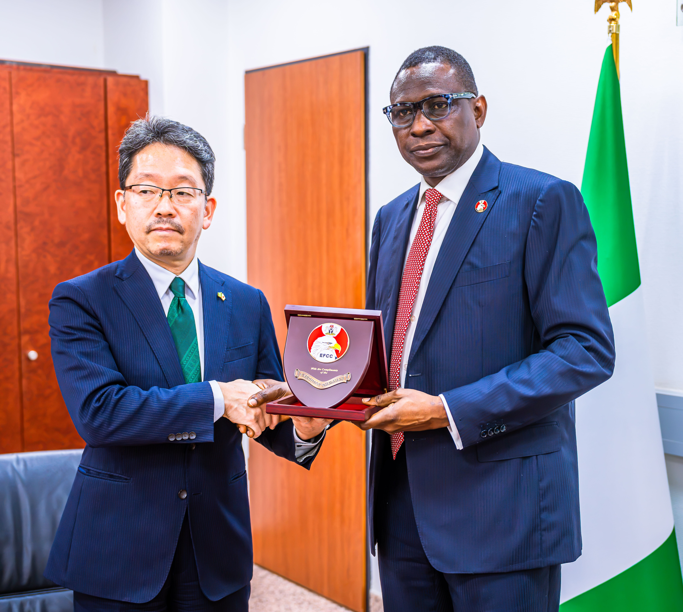
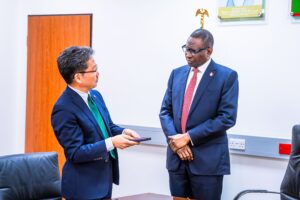
The Japanese Ambassador-Designate to Nigeria, His Excellency, Hideo Suzuki Paid a Courtesy Visit to the Executive Chairman of the Economic and Financial Crimes Commission, EFCC, Mr. Ola Olukoyede in his office today, October 28, 2026. He was accompanied on the visit by First Secretary, Security, Yuji Murakami and Senior Information Analyst, Dogara Ankut.




EFCC Counsel Misquoted in ALGON Lawyer’s Fraud Allegation Judgment

KC Luxury Seeks Judge’s Recusal Over Missing Bail Ruling

Zenith Bank Reinforces Commitment To Africa’s Creative Economy Through Continued Sponsorship Of Art X Lagos 2026

Alleged ₦1.4bn Oil Fraud: EFCC Re-Arraigns Nadabo Energy Boss, Ali Peters, Firm in Lagos

Alleged ₦1.06bn Fraud: EFCC Secures Court Order to Freeze Suspect’s Account

Again, Dangote Refinery Hikes Petrol To ₦1,175/Litre, Diesel To ₦1,620/Litre — Report
-
 EFCC7 months ago
Alleged ₦1.4bn Oil Fraud: EFCC Re-Arraigns Nadabo Energy Boss, Ali Peters, Firm in Lagos
-
 EFCC2 weeks ago
Alleged ₦1.06bn Fraud: EFCC Secures Court Order to Freeze Suspect’s Account
-
 News8 months ago
Again, Dangote Refinery Hikes Petrol To ₦1,175/Litre, Diesel To ₦1,620/Litre — Report
-
EFCC4 weeks ago
EFCC Hands Over Recovered ₦107m to Property Fraud Victim in Lagos
-
 News9 months ago
Senate Retains Two-Year Jail Term for PVC Trading, Raises Fine to ₦5m
-

 EFCC8 months ago
Lagos Court Jails Man 18 Months for Defrauding Sterling Bank of ₦30m
-

 Economy8 months ago
Naira Rebounds To ₦1,363.5/$
-

 Economy9 months ago
Naira Closes in the Red at ₦1,341.35/$