
Judiciary
Court to Rule May 4 on Admissibility of Co-Defendant’s Statement in Emefiele Trial

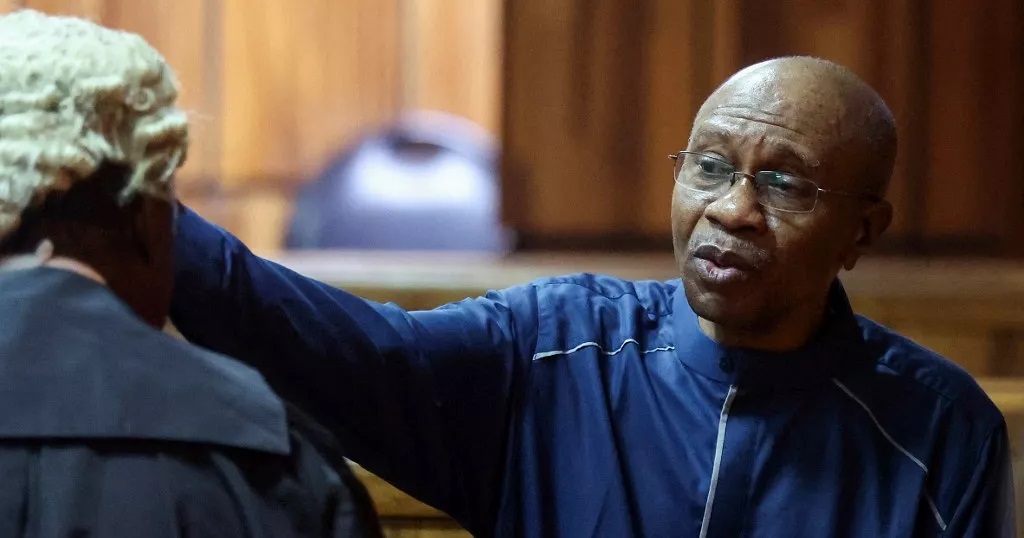
An Ikeja Special Offences Court has fixed May 4, 2026, for ruling on the admissibility of an extra-judicial statement made by Henry Omoile, a co-defendant in the ongoing trial of former Central Bank of Nigeria (CBN) Governor, Godwin Emefiele.
The court scheduled the ruling date after counsel to both the defence and the prosecution adopted their respective written addresses on the admissibility or otherwise of the statement of the second defendant during the trial-within-trial.
Emefiele is standing trial on a 19-count charge bordering on alleged gratification, corrupt demands, and abuse of office linked to large-scale financial transactions.
Omoile, his associate, faces a three-count charge relating to the alleged unlawful acceptance of gifts while acting as an agent in transactions connected to the CBN.
The charges involve alleged transactions estimated at $4.5 billion and ₦2.8 billion, which the prosecution claims represent serious breaches of trust and procedure.
Justice Rahman Oshodi had earlier adjourned proceedings for the adoption of final written addresses following the conclusion of evidence, including the cross-examination of Omoile in the trial-within-trial.
Adopting the second defendant’s written address, his counsel, Adeyinka Kotoye, SAN, argued that the key issue before the court is whether the statement attributed to his client was made voluntarily.
He contended that the process of obtaining the statement did not comply with mandatory provisions of the law, particularly Sections 9(3) and (4) of the Administration of Criminal Justice Law (ACJL) and Sections 17(1) and (2) of the Administration of Criminal Justice Act (ACJA).
He emphasised that where voluntariness is in dispute, video recording of the interrogation process is crucial.
Relying on Supreme Court authorities, he argued that video evidence is the most reliable means of verifying compliance with due process.
Kotoye further submitted that the prosecution failed to provide independent evidence to corroborate the alleged confessional statement and questioned the role of the legal practitioner said to have been present during its recording, alleging that the lawyer was prevented from effectively performing his duty.
Counsel also argued that the prosecution misapplied relevant statutory provisions by limiting them to confessional statements alone, whereas the law applies broadly to statements made during investigation.
He suggested that the statement may have been influenced by coercion or inducement and urged the court to reject it.
Similarly, counsel to the first defendant, Olalekan Ojo, SAN, urged the court to resolve any doubt regarding the voluntariness of the statement in favour of the defence.
He relied on Section 29(2) of the Evidence Act, which renders inadmissible any statement obtained through oppression, inducement, or improper means.
Ojo argued that once voluntariness is challenged, the burden shifts to the prosecution to prove, on the balance of probability, that the statement was freely made.
He maintained that the prosecution failed to discharge this burden, noting that the circumstances surrounding the statement raise serious doubts about its credibility.
He further submitted that established judicial authorities underscore that only voluntary confessions are admissible, adding that modern criminal procedure recognises the importance of safeguards such as video recordings.
Ojo also faulted the prosecution for failing to challenge key aspects of the defendant’s testimony, including allegations of trauma, inducement, and lack of proper legal representation, arguing that such omissions are fatal to the prosecution’s case.
In opposition, the Director of Public Prosecutions (DPP) in the Federal Ministry of Justice, Rotimi Oyedepo, SAN, urged the court to dismiss the defence submissions.
Oyedepo argued that counsel to the first defendant lacked the basis to challenge the admissibility of the second defendant’s statement, having initially declined to object when it was tendered.
He described the subsequent challenge as an abuse of court process.
He maintained that the statement was obtained in substantial compliance with the provisions of the ACJA, adding that although it was not video-recorded, it was made in the presence of the second defendant’s counsel.
The DPP further submitted that the contents of the second defendant’s statement undermine the defence’s claim of coercion.
He pointed out that the second defendant, in the statement, expressly refused to implicate the first defendant, Godwin Emefiele, in any wrongdoing.
According to him, this position demonstrates that the statement was not made under duress or undue influence, as the defendant maintained an independent stance rather than yielding to any alleged pressure from investigators.
Oyedepo also noted that the second defendant, in the same statement, denied committing all the offences alleged against him in the charge.
He argued that such denials are inconsistent with the suggestion that the statement was extracted through coercion, intimidation, or inducement.
He therefore urged the court to hold that the statement was voluntarily made and remains admissible in evidence.
The DPP also dismissed allegations of intimidation, stating that the statement was taken in the presence of several individuals, making coercion unlikely.
He added that the defendant was duly cautioned and voluntarily signed the cautionary form before making the statement.
Following the adoption of written addresses by all parties, Justice Oshodi adjourned the matter for ruling on May 4, 2026, and fixed June 26 and June 30, 2026, for the continuation of the substantive trial.

A Federal High Court in Lagos has dismissed an application by Afolabi Michael Kazeem seeking to overturn an order extending his detention for 30 days over his alleged involvement in the trafficking of 184.5 kilogrammes of cocaine.
The court held that the detention extension order granted on August 20, 2026, was properly issued and backed by the Constitution and relevant drug-control laws.
Kazeem, popularly known as KC Luxury, through his lawyer, Abdulakeem Labi-Lawal, SAN, had asked the court to set aside or strike out the order, arguing that the court lacked jurisdiction to extend his detention.
The lawyer contended that only a Magistrate Court could issue a remand order under Sections 293 to 299 of the Administration of Criminal Justice Act, 2015, describing the detention extension as an unlawful interference with the suspect’s constitutional right to personal liberty.
However, the National Drug Law Enforcement Agency (NDLEA), through its lawyer, Abu Ibrahim, dismissed the argument as a misconception of the nature of the order granted by the court.
Abu maintained that the August 20 order was not a remand order under the ACJA but an extension of detention granted to enable the relevant agency to conduct detailed investigations into the alleged drug-trafficking offence.
According to the ruling, Kazeem was arrested on August 13, 2026, at the departure hall of the Murtala Muhammed International Airport, Lagos, while allegedly attempting to travel to Paris, France.
The NDLEA had told the court that the suspect’s arrest followed the seizure of 184.5kg of cocaine at DHL in Ikeja, Lagos, with the agency alleging that Kazeem, popularly known as KC Luxury, was connected to the shipment.
Delivering judgment on the application on Thursday, Justice Aluko held that Sections 293 to 299 of the ACJA, which deal with remand proceedings, were not applicable to the case before the court.
The judge also held that the court has “exclusive” jurisdiction over drug-related matters by virtue of Section 251(1)(m) of the Constitution and Section 26(1) of the NDLEA Act.
The judge further held that the evidence presented by the NDLEA established reasonable suspicion of a drug-related offence, justifying the temporary deprivation of liberty under Section 35 of the Constitution.
Justice Aluko consequently dismissed KC Luxury’s application, holding that it constituted an abuse of court process and lacked merit.
I am a lawyer. I studied law and have remained in the practice of law in memory of my late mother, who paid for me to study law at Holborn Law Tutors in the UK. I eventually continued my legal education at the University of Ibadan and graduated from there. She paid almost £7,000 upfront for one year, which was the total tuition fee for one year at that private law school. I will be eternally grateful to her. May her soul continue to rest in perfect peace. We all know what the exchange rate would be today.
In her memory, I decided to remain in the practice of law throughout my legal practice and thereafter, even until now. I tried my hand at property marketing at one time, but I had to drop it, even though I made some money from it. I stopped because it was affecting my legal practice.
There is nothing you do, from my point of view, outside your profession that will not affect your profession. Politics is one of them. Politics itself is an art and a profession, but I must add that, if it is truly for the people and the betterment of the people, it is a good one.
One of the most respected politicians in this country was Chief Obafemi Awolowo, of blessed memory. He practised law and politics successfully, but he was more of a politician. He used his knowledge of law to better the lot of so many people during his lifetime, and, till today, his name remains a reference point in using politics to serve humanity.
Mahatma Gandhi was first a lawyer before he became a politician to serve his people. His name is known more in politics than in law.
Chief F.R.A. Williams was a politician until he dropped politics to devote his entire life to law. He was not a crossbreed. His pathological devotion to law can be seen and read in the political history of Nigeria. In legal practice, to which he committed his entire life after publicly renouncing politics, his invaluable impact is evident in law books, legal records and law reports. He was an enigma and an icon who will forever be remembered, like others too numerous to name, who stayed in the service of law.
The lawyer is meant to be the beacon of society. The lawyer’s creed is to ensure that society is governed according to the law. Chief Gani Fawehinmi was the people’s lawyer. He used the law to better the lot of society. His foray into politics was disastrous because the perception of the lawyer in practice and the lawyer in politics are not symbiotic. They are strange bedfellows.
The people may hail the lawyer in law, but not the lawyer in politics. The ingredients you add to the soup that make a lawyer are different from the ingredients you add to the soup that make a politician. Femi Falana, SAN, my dear friend, was in the same boat as the late Chief Gani Fawehinmi. I feel him more in law now than when he did both.
A lawyer is known to keep to his or her word. Robert Traver, in his book The Anatomy of Murder, stated thus:
“That’s what makes the practice of law, like prostitution, one of the last of the unpredictable professions—both employ the seductive arts, both try to display their wares to best advantage and both must pretend enthusiastically to woo total strangers.”
Joseph Story lived from 1779 to 1845. He was an American lawyer, politician and jurist who served as an Associate Justice of the United States Supreme Court from 1812 until his death in 1845. He stated thus:
“I will not say….that ‘The law will admit of no rival’, but I will say that it is a jealous mistress, and requires a long and constant courtship. It is not to be won by trifling favours…”
Henry David Thoreau (1817–1862) was not a lawyer. He was an American essayist, poet and philosopher. He said:
“The lawyer’s truth is not Truth, but consistency, or a consistent expediency. Truth is always in harmony with herself, and is not concerned chiefly to reveal the justice that may consist with wrongdoing.”
I have gone through the lawyer’s creed, which is to uphold the rule of law, personal dignity and independence; to offer faithfulness, competence, diligence and good judgment while providing vigorous and honest representation without sacrificing professional ethics; to practise with fairness, integrity and civility, avoiding malicious tactics, unnecessary delays or abusive discovery; to show profound respect, candour and courtesy, ensuring that the search for truth and justice remains uncompromised; to the court or tribunal; to make justice accessible to the poor; and to protect the legal profession as a noble calling rather than a mere business.
I have gone this far in order to buttress the topic for discussion. The practice of law and politics can never converge. You cannot be a master of both. You can be successful in both, no doubt, but along the way, there are sacrifices that will most likely be at cross-purposes with the law.
Very few lawyers, like Chief F.R.A. Williams, of blessed memory, have sacrificed politics for law. The political lawyer will criticise anything, even when the law is clear that, without evidence, you are not expected to speculate.
Nowadays, many lawyers in politics take to the airwaves and the print media, especially in this era of social media, to generalise when making statements. How can a lawyer, trained in the practice of law, make general statements on any topic, especially these days when the judiciary, even in retirement, has become a topic for discussion without any evidence? How can people make general statements about Senior Advocates of Nigeria or lawyers generally?
It is pathetic that those who ought to know, by virtue of their level of education, professional qualifications and recognition in the legal community, are more guilty of this. How can a lawyer remain silent even when injustice happens in front of him and behind him, too, but he keeps quiet?
Many keep quiet these days because they want to satisfy their paymasters, even when it is glaring that the legal profession is suffering from their silence and/or complicity and complacency. These days, many voice personal opinions without let or hindrance for personal and political reasons. Some attack their professional colleagues, even the judiciary, when they cannot get what they want, but they must vent their anger on someone. Some are paid to attack or bring down their fellow colleagues, whether at the Bar or on the Bench.
I like the Yoruba language a lot. I am sorry I will not be able to interpret the idioms I will use:
“Tó bá máa jẹ Oshakala, jẹ Oshakala; tó bá máa jẹ Oshokolo, jẹ Oshokolo. Oshakala, Oshokolo kò yẹ ọmọ ènìyàn.”
“Arítení mo ń wí, àfi àpáàdì bó tiẹ̀ mọ́lẹ̀.”
“Kò sí ẹni tí a máa sí idi ẹ̀, tí a kò ní bá ẹ̀ẹ̀pà níbẹ̀.”
Apologies to those who will read this who are not Yoruba, or those who are Yoruba but do not understand these idioms.
To those who criticise, not out of holiness per se, not out of being a “straight” lawyer or simply out of a desire to be fair, but generalise in order to look good or elicit unmerited applause, look in the mirror and think back to whether you have not done anything you accuse others of doing.
In writing or criticising generally, come out, but most importantly, PRACTISE WHAT YOU PREACH BEFORE YOU CRITICISE.



Alleged $6b Mambilla Power Contract: Tinubu Hails EFCC for FG’s Victory at Arbitration Tribunal

EFCC Hands Over Recovered N140m to Loan Firm in Lagos

COPSUN Applauds EFCC on NELFUND
Nigerian nurses stage seven‑day warning strike over pay, staffing

Dangote Refinery to deploy 4,000 gas‑powered trucks for distribution

Nigeria approves plan to refinance ₦4tn power-sector debt
-
Health1 year ago
Nigerian nurses stage seven‑day warning strike over pay, staffing
-
Energy1 year ago
Dangote Refinery to deploy 4,000 gas‑powered trucks for distribution
-
Economy1 year ago
Nigeria approves plan to refinance ₦4tn power-sector debt
-
 Education1 year ago
JAMB sets 2025/26 university cut‑off at 150, bars under‑16
-
 Entertainment1 year ago
Sean Kingston sentenced to 3½ years in prison over $1 million fraud
-
 Crime & Justice7 months ago
BREAKING: Two Chinese Directors Jailed 46 Years Each Over ₦3.4bn, $2.5m Crypto Fraud in Lagos
-

 Business7 months ago
Nigeria Revenue Service Collects ₦28.3trn in 2025, Sets ₦40.7trn Target for 2026
-

 Crime & Justice8 months ago
Police Arrest 24-Year-Old Over ₦48.5m Romance Fraud in Lagos