
Judiciary
Court Orders Final Forfeiture of 52 Houses in Lagos


Justice Alexandra Owoeye of the Federal High Court sitting in Ikoyi, Lagos, on Wednesday, July 15, 2026, ordered the final forfeiture of 52 terrace and maisonette units located in the Lekki area of Lagos.
The properties, situated at Mercyville Estate, Covenant Way, off New Road, Ilasan, Lagos, were recovered from Fielddreams Limited, Ifeanyi Nweke, and Amex Savings and Loans Limited.
The judge made the order following a Motion on Notice filed and argued by the Lagos Zonal Directorate 2 of the Economic and Financial Crimes Commission (EFCC) through its counsel, Franklin Ofoma.
The Commission had, on August 14, 2024, secured an interim forfeiture order on the properties through Justice Akintayo Aluko, following an ex parte application filed by the EFCC through Ofoma.
The interim forfeiture order was made in favour of Dr. Kennedy Okonkwo, a real estate developer and Chief Executive Officer of Capital Gardens Limited.
In his ruling, Justice Aluko also directed the Commission to publish the interim forfeiture order in a national newspaper, inviting any interested party to show cause why the properties should not be finally forfeited to the Federal Government of Nigeria.
Following the publication, the respondents filed an affidavit to show cause why the court should not grant the final forfeiture of the properties.
In paragraphs 16 to 25 of their affidavit, the respondents stated that the funds used to develop the 52 terrace and maisonette units were derived from the sale of a portion of land acquired through the sale of 29 terrace and maisonette units valued at ₦1.9 billion.
However, they subsequently reversed their position and accused the 3rd to 19th applicants of failing to complete the various terrace and maisonette units.
This contradicted their earlier affidavit evidence, in which they had stated that the proceeds from the sales were used to complete the furnishing and interior decoration of the remaining units and that construction had been completed in 2020.
At Wednesday’s proceedings, Ofoma, while moving the application for final forfeiture, informed the court that the Commission had fully complied with the court’s directive regarding the publication of the interim forfeiture order.
He further told the court that the application was supported by a 31-paragraph affidavit deposed to by Afolabi Seyi Oladele, a litigation officer in the Legal Department of the EFCC.
According to him, the properties were reasonably suspected to be proceeds of unlawful activities, and he urged the court to grant the application for final forfeiture.
Ofoma further submitted that the second respondent, Nweke, is a fugitive from justice, adding that he: “Has refused to appear before Justice R.A. Oshodi and Justice Okunuga in Charge No. ID/25771C/2025 and Charge No. ID/25769C/2025 for his arraignment and to defend the charges if he believes that he did not commit any of the offences contained therein.”
He also informed the court that there were two subsisting warrants of arrest against the second respondent and that he had jumped the administrative bail earlier granted to him by the Commission in connection with the alleged offences.
After hearing the submissions of both the applicant and the respondents, Justice Owoeye held: “Premised on the foregoing position of the law, I hold that since this court cannot pick and choose which of the evidence given by the Respondents to believe, it must consequently reject the entire affidavit evidence placed before it by the 1st–3rd Respondents.
“Accordingly, I reject the 1st–3rd Respondents’ Affidavit to Show Cause/Counter-Affidavit to the Applicant/Respondent’s Motion on Notice for Final Forfeiture filed on February 9, 2026, but deemed properly filed on April 28, 2026.
“The consequence is that there is no opposition to the Motion filed by the 1st and 2nd Applicants for the grant of an order of final forfeiture.”
The judge further held: “Premised on the foregoing, I find that, having demonstrated grounds for reasonable suspicion that the properties in question are the proceeds of unlawful activities, the applicants are entitled to the reliefs sought in this application. I therefore resolve the sole issue in this application in favour of the Applicants.”
In the final analysis, the court held: “Having resolved the sole issue in this application in favour of the applicants, I hold that this application has merit and ought to be granted. Accordingly, I grant the relief sought in this application as prayed.”

The second prosecution witness (PW2) in the trial of Ojoba Joshua and Aliyu Haskim, who are being prosecuted for allegedly impersonating the Personal Assistant (PA) to the Executive Chairman of the Economic and Financial Crimes Commission (EFCC), Ola Olukoyede, on Thursday, November 5, 2026, told Justice Jude Onwuegbuzie of the Federal Capital Territory (FCT) High Court, Apo, Abuja, that the first defendant, Joshua, told him he was the EFCC Chairman’s PA in the presence of the second defendant.
The EFCC is prosecuting Joshua and Haskim on an amended four-count charge bordering on impersonation, conspiracy and obtaining $700,000 (Seven Hundred Thousand United States Dollars) by false pretence.
Joshua, the first defendant, allegedly paraded himself as Olukoyede’s Personal Assistant and conspired with Haskim, the second defendant, to obtain $700,000 from a former Managing Director of the Nigerian Ports Authority (NPA), Muhammed Bello Koko.
Both defendants allegedly posed as EFCC operatives and approached Koko, claiming that his tenure as NPA Managing Director was under investigation by the Commission. They further claimed that the EFCC Chairman and the Director of Operations had demanded $1 million to halt the investigation. They eventually agreed to collect $700,000 from Koko.
At Thursday’s proceedings, the witness, Tanko Abubakar, an EFCC investigating officer, made the disclosure while being cross-examined by counsel to the first defendant, Obinna Nwosu.
Abubakar told the court that he encountered Joshua during his investigation and that the first defendant introduced himself as the PA to the EFCC Chairman.
When asked to provide evidence to support his claim, the witness said video clips showed the second defendant stating in his statement that Joshua had introduced himself as the EFCC Chairman’s PA.
“My Lord, there are video clips to show when the second defendant said in his statement that he is the PA to the EFCC Chairman. He said this when we were driving in the car,” he said.
The witness was further asked to identify the specific portions of the video evidence in which the alleged disclosure was recorded.
In response, the judge observed that playing the entire video clips would consume valuable court time. He consequently directed the prosecution to review the recordings, identify the relevant portions and present them at the next adjourned date.
Counsel to the prosecution, Elizabeth Alabi, also drew the court’s attention to an affidavit seeking leave to call her next witness virtually, explaining that the witness would be unable to appear physically because he was outside the country.
Justice Onwuegbuzie granted the application and adjourned the matter to November 9, 16, 19, 23 and 30, 2026, for continuation of trial.
Judiciary
Court Admits Statements, Video Recordings Against Alleged Coup Plotters, Fixes December 7 for Trial
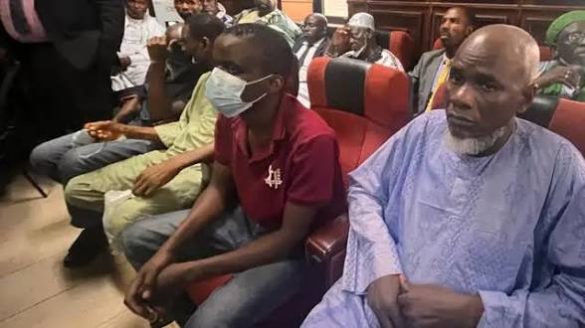
A Federal High Court sitting in Abuja has dismissed objections by alleged coup plotters to the admissibility of statements and video recordings made during their interrogation by the military over an alleged plot to overthrow the government of President Bola Tinubu.
When the case came up on Thursday, the trial judge, Justice Joyce Abdulmalik, upheld the Federal Government’s submission that the statements and video recordings were voluntarily made by the defendants during military interrogation.
In a ruling following a trial-within-trial conducted to determine the voluntariness of the defendants’ statements, Justice Abdulmalik held that there was no evidence that the statements and video recordings were obtained under duress.
She described the defendants’ allegations of duress as an afterthought and unbelievable in all ramifications.
The judge specifically dismissed claims of torture, inducement and the use of force by the military to obtain the defendants’ confessional statements and video recordings. She subsequently admitted the statements and recordings as exhibits against the defendants.
The alleged coup plotters are retired Major General Mohammed Gana, retired Navy Captain Erasmus Victor, Inspector Ahmed Ibrahim, Zekeri Umoru, Bukar Goni and Abdulkadir Sani, listed as the first to sixth defendants, respectively.
The Federal Government, through the Office of the Attorney-General of the Federation (AGF), arraigned the six defendants on April 22 on a 13-count charge marked FHC/ABJ/CR/206/2026, filed on April 20 by the Director of Public Prosecutions of the Federation (DPPF), Mr Rotimi Oyedepo, SAN.
The defendants were accused of offences bordering on treason, terrorism, failure to disclose security intelligence and money laundering linked to terrorism financing.
Justice Abdulmalik had, on May 11, ordered a trial-within-trial after defence lawyers objected to the admissibility of the statements and video recordings the prosecution sought to tender, arguing that they were not made voluntarily. The objection followed the prosecution’s presentation of four witnesses.
The fourth prosecution witness (PW-4), an army officer identified by the codename “AAA”, had earlier tendered video recordings of the defendants’ interrogations before the trial-within-trial commenced.
Following Thursday’s ruling, the judge fixed December 7 and 10 for the continuation of the trial.
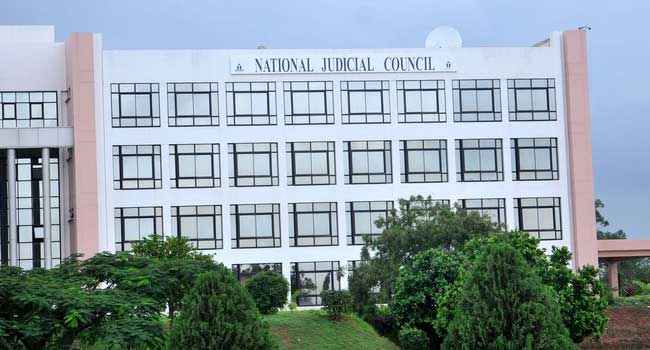
The National Judicial Council (NJC) has sanctioned three judicial officers with one-year suspensions without pay over acts of judicial misconduct, while six others have been cautioned or issued warning letters for various breaches of judicial ethics and due process.
The disciplinary actions, taken at the Council’s 112th meeting held on November 3, 2026, under the chairmanship of the Chief Justice of Nigeria, Justice Kudirat Kekere-Ekun, also include restrictions on the promotion of two of the suspended judges for three years.
The three suspended judicial officers are Justice Hannatu Mohammed Kabir of the Nasarawa State High Court, Grand Kadi Mohammed Sani Salihu of the Jigawa State Sharia Court of Appeal and Justice Sobere Biambo of the Rivers State High Court.
In a statement issued on Wednesday by the NJC’s Deputy Director of Information, Kemi Babalola-Ogedengbe, the Council said Justice Kabir was sanctioned for unlawfully detaining a litigant for 58 days over alleged disobedience of court orders without complying with the mandatory procedures for contempt proceedings.
The investigation committee found that the judge ordered the litigant’s arrest and detention without issuing and serving Forms 48 and 49 or instituting proper contempt proceedings.
It held that the alleged contempt was committed outside the court’s presence and could not lawfully be dealt with through summary proceedings. The committee also found that the judge’s actions violated the litigant’s right to a fair hearing. Consequently, the Council approved her suspension for one year without pay and barred her from being considered for elevation for three years.
Similarly, Grand Kadi Salihu was suspended for one year without pay for exceeding his judicial authority by reopening a judgment delivered by the FCT Upper Area Court.
The NJC found that the Grand Kadi constituted a committee to review the judgment and subsequently assigned the matter to a Higher Sharia Court judge, who received fresh evidence and delivered another judgment.
The Council held that the process amounted to an appeal against a valid judgment of a court of competent jurisdiction, which was subsequently set aside by the Jigawa State High Court. It also found that his conduct breached Rule 3.3.1 of the Revised Code of Conduct for Judicial Officers, 2016.
The Council directed the most senior Kadi of the Jigawa State Sharia Court of Appeal to perform the functions of the Grand Kadi during his suspension.
The third judicial officer, Justice Biambo of the Rivers State High Court, was sanctioned for issuing bench warrants and imposing fines on litigants in a civil dispute without following due process.
According to the NJC, the judge ordered the arrest of the petitioners for alleged disobedience of an interim injunction and subsequently imposed a fine of ₦300,000 on each of them without instituting contempt proceedings or serving Forms 48 and 49.
The investigation committee held that the alleged contempt occurred outside the court’s presence and could not lawfully be tried and punished summarily. The Council consequently approved his one-year suspension without pay and barred him from being considered for elevation for three years.
Beyond the suspensions, the NJC approved the issuance of warning letters or cautions to six other judicial officers following investigations into complaints bordering on disregard for court orders, delayed judgments, abuse of judicial powers and breaches of due process.
Among them is Justice Bello Kawu of the Federal Capital Territory High Court, who was found to have acted improperly by granting interim bail to former Attorney-General of the Federation, Abubakar Malami, SAN, despite a subsisting remand order issued by another judge of the same court.
The investigation committee found that Justice Kawu was aware that the remand order was due to expire at midnight on December 24, 2025, but granted interim bail on December 23, 2025, in conflict with the subsisting order.
The Council directed that he be issued a warning letter and placed on its Watch List.
Two Nasarawa State High Court judges, Justices Danjuma A. Oyigbenu and Isa Ebini Kana, were also found culpable of failing to deliver judgment in an appeal within the constitutionally prescribed 90-day period.
The NJC rejected their argument that the constitutional provision did not apply to appellate courts, noting that they admitted delivering judgment outside the stipulated period without providing a satisfactory explanation for the delay.
The Council directed that warning letters be issued to them for breaching Section 294 of the 1999 Constitution, as amended, and advised them to improve their case management.
Justice Mohammed Zubairu of the FCT High Court was cautioned and placed on the Council’s Watch List for entertaining an application and making orders after being informed that an appeal had already been entered at the Court of Appeal.
The investigation committee held that his actions amounted to disregard for the appellate court and bordered on judicial insubordination.
Similarly, Justice C. A. Ogbuagor of the Enugu State High Court was cautioned for allegedly displaying judicial impertinence, denying a party fair hearing and disregarding due process and court hierarchy by continuing proceedings despite a pending appeal and an application for a stay of proceedings.
The Council advised him to familiarise himself with the laws and procedures governing appeals.
Justice Chibuike L. Azuama of the Imo State High Court was also cautioned and placed on the Watch List after the NJC found that he granted an ex parte garnishee order freezing the bank accounts of Puma Energy, a company that was not a party to the substantive suit, thereby causing it substantial losses.
Meanwhile, the Council recommended 28 candidates for appointment to various judicial positions across five states and the Sharia and Customary Courts of Appeal in Plateau and Adamawa states.
The recommendations comprise 24 candidates for appointment as judges of the High Courts of Kano, Ebonyi, Edo, Adamawa and Ogun states; one Grand Kadi for the Plateau State Sharia Court of Appeal; one Kadi for the Adamawa State Sharia Court of Appeal; and two judges for the Adamawa State Customary Court of Appeal.
The candidates are expected to be sworn in by their respective state governors without delay.
In another significant decision, the NJC directed the Imo State Judicial Service Commission to include the name of the Acting Chief Judge and most senior judge of the state’s High Court, Justice Ijeoma Agugua, in the shortlist of candidates for appointment as substantive Chief Judge.
The decision followed a petition dated June 11, 2026, by Mr Bob Kay Njemanze, challenging her exclusion from the shortlist submitted by the State Judicial Service Commission.
The Council noted that although the State Judicial Service Commission has the constitutional responsibility to advise it on suitable candidates for appointment as Chief Judge, the NJC retains the authority to determine the suitability of persons presented for judicial appointments.
It consequently directed its secretariat to formally request the Imo State Judicial Service Commission to include Justice Agugua’s name in the shortlist.
The Council also considered reports on 35 petitions submitted by its Preliminary Complaints Assessment Committees. It dismissed 24 for lack of merit, recommended four for further investigation and placed one in abeyance because the matter was sub judice.
Two petitions against Justice B. M. Balarabe of the Kaduna State High Court and Justice Evelyn N. Anyadike were dismissed following their withdrawal by the petitioners.
A petition against Justice Peter O. Ikujuni of the Ondo State High Court was struck out because it had been leaked and published on social media, contrary to the provisions of the National Judicial Policy, 2016.
Another petition against Justice Abdullahi Mika’ilu of the Niger State High Court was dismissed for want of diligent prosecution.
However, the Council resolved that an investigation into a petition against Justice G. N. Ugbala of the Ebonyi State High Court should continue despite the petitioner’s notice of withdrawal.
The NJC also approved the retirement notifications of six judicial officers, including two Supreme Court justices, one Court of Appeal justice and three state High Court judges.
They are Justices Ibrahim Mohammed Musa Saulawa and Uwani Musa Abba Aji of the Supreme Court; Justice O. F. Omoleye of the Court of Appeal; Justice Ogechi Okehielem of the Abia State High Court; Justice Theresa Isidore Obot of the Akwa Ibom State High Court; and Justice Munir Muhammad Ladan of the Kaduna State High Court.
While Justices Saulawa, Omoleye and Okehielem have already retired, Justices Abba Aji, Obot and Ladan are due to retire on November 7, December 30 and December 31, 2026, respectively.
The Council commended the retiring judicial officers for their dedicated and meritorious service to the judiciary and the nation.
It also expressed condolences to the families of nine judicial officers who died between May 1 and September 26, 2026, as well as the Nigerian legal community.
The deceased include Justices Mohammed Nasir Yunusa of the Federal High Court, Kano Division; Sambo Sammy Daka of the Kaduna State High Court; Josephine Efunkumbi Oyefeso of the Lagos State High Court; Musa Mohammed Dallah of the Nasarawa State High Court; Bello Muhammed Shinkafi of the Zamfara State High Court; Edem Nyong Okokon of the Cross River State High Court; Kadi Aliyu Mani Yauri of the Kebbi State Sharia Court of Appeal; Justice Dorothy Sim Inwulale of the Kaduna State Customary Court of Appeal; and Justice Legor Torbira Senewo of the Rivers State Customary Court of Appeal.
The NJC prayed for the peaceful repose of their souls.



Alleged $700,000 Fraud: First Defendant Told Me He Was PA to EFCC Chairman – Witness

Court Admits Statements, Video Recordings Against Alleged Coup Plotters, Fixes December 7 for Trial

NJC Suspends Three Judges for One Year Without Pay, Cautions Six Others

Alleged ₦1.06bn Fraud: EFCC Secures Court Order to Freeze Suspect’s Account

Alleged ₦1.4bn Oil Fraud: EFCC Re-Arraigns Nadabo Energy Boss, Ali Peters, Firm in Lagos

Again, Dangote Refinery Hikes Petrol To ₦1,175/Litre, Diesel To ₦1,620/Litre — Report
-
 EFCC2 weeks ago
Alleged ₦1.06bn Fraud: EFCC Secures Court Order to Freeze Suspect’s Account
-
 EFCC7 months ago
Alleged ₦1.4bn Oil Fraud: EFCC Re-Arraigns Nadabo Energy Boss, Ali Peters, Firm in Lagos
-
 News8 months ago
Again, Dangote Refinery Hikes Petrol To ₦1,175/Litre, Diesel To ₦1,620/Litre — Report
-
EFCC1 month ago
EFCC Hands Over Recovered ₦107m to Property Fraud Victim in Lagos
-

 EFCC8 months ago
Lagos Court Jails Man 18 Months for Defrauding Sterling Bank of ₦30m
-
 News9 months ago
Senate Retains Two-Year Jail Term for PVC Trading, Raises Fine to ₦5m
-

 Economy8 months ago
Naira Rebounds To ₦1,363.5/$
-

 Economy9 months ago
Naira Closes in the Red at ₦1,341.35/$