
Judiciary
Court Orders Final Forfeiture of ₦81.1m as Part of ₦2.5bn Stolen from Sterling Bank


Justice Yelim Bogoro of the Federal High Court sitting in Ikoyi, Lagos, on Monday, March 9, 2026, ordered the final forfeiture of the sum of ₦81,108,143.08 (Eighty-one million, one hundred and eight thousand, one hundred and forty-three naira, eight kobo) to the Federal Government of Nigeria in favour of Sterling Bank Plc.
The judge gave the order following a motion on notice filed by the Economic and Financial Crimes Commission (EFCC) through its counsel, Hannatu U. KofarNaisa.
The court had, on October 2, 2025, granted an interim forfeiture order on the funds and also directed the publication of the order in a national newspaper for any interested party to show cause why the money should not be finally forfeited to the Federal Government.
The money was part of the over ₦2,500,000,000 (Two billion, five hundred million naira) stolen by some customers of Sterling Bank and transferred for their personal use as well as to third-party beneficiaries due to a system glitch experienced by the bank.
Upon receipt of a petition from the bank on July 18, 2022, the Commission commenced investigations which led to the identification and tracing of the stolen funds to various accounts, including that of a customer, Sulaiman Kehinde Ojora, who was one of the major beneficiaries of the fraud.
Investigations further revealed that Ojora fraudulently concealed the sum of ₦43,000,000 in the account of his friend, Taiwo Oluwaseyi Alawode (Account No. 1233126860), domiciled in Access Bank, and the sum of ₦122,200,009 in the account of his wife, Aminat Olatanwa Ojora (Account No. 0072889319), domiciled in Sterling Bank.
Moving the motion for the final forfeiture order on Monday, counsel to the EFCC, H. U. KofarNaisa, stated that the application was supported by an affidavit deposed to by Maina Gapani Gyal, an investigator with the EFCC.
In the affidavit, Gyal stated that he was one of the operatives of the Commission assigned to investigate the petition received from the bank on July 18, 2022, regarding the alleged fraud.
He stated:
“That over ₦2,500,000,000 (Two billion, five hundred million naira) was stolen by some customers of the bank and converted to their personal use as well as to the use of third-party beneficiaries.
“The fraud and unauthorized transfer of funds occurred due to a system glitch in the bank, which enabled customers to exploit the system and steal the funds.”
He added that the glitch allowed customers to use the PAYATTITUDE Global Ltd banking platform (an e-wallet and payment scheme subscribed to by Sterling Bank Plc) to illegally transfer funds even when their Sterling Bank accounts were not funded.
According to him, the petitioner alleged that the bank was unable to recover the total sum of ₦295,916,201.02 (Two hundred and ninety-five million, nine hundred and sixteen thousand, two hundred and one naira, two kobo) from the fraud, as the funds had been withdrawn and converted by the bank’s customers.
He further stated that the funds were fraudulently concealed in Account No. 1233126860 belonging to Taiwo Oluwaseyi Alawode, domiciled in Access Bank Plc, and Account No. 0072889319 belonging to Aminat Olatanwa Ojora, domiciled in Sterling Bank Plc.
Gyal added that the bank was able to salvage the total sum of ₦81,108,143.08, which is now being sought for final forfeiture, as well as ₦490,349,000 (Four hundred and ninety million, three hundred and forty-nine thousand naira) from the bank’s internal ledger.
KofarNaisa therefore told the court that the money was reasonably suspected to be proceeds of unlawful activities.
She also informed the court that the Commission had published the interim forfeiture order in The Punch newspaper of February 19, 2026, inviting any interested party to show cause why the final forfeiture order should not be made in favour of the Federal Government of Nigeria.
Justice Bogoro, after listening to the EFCC counsel’s submissions, held:
“Having gone through the motion and attachments, I find the application meritorious and the same is accordingly granted.”
Consequently, the judge ordered the final forfeiture of the money to the Federal Government of Nigeria in favour of Sterling Bank Plc.
Judiciary
Alleged ₦76bn, $31.5m Fraud: Witness Says Kuru Approved Arik Air Receivership Without Prior AMCON Board Approval

The trial of a former Managing Director and Chief Executive Officer of the Asset Management Corporation of Nigeria (AMCON), Ahmed Kuru, and four others over an alleged ₦76 billion and $31.5 million fraud continued on Monday, October 26, 2026, with the fourth prosecution witness (PW4), Bawa Usman Kaltungo, telling Justice Mojisola Dada of the Special Offences Court sitting in Ikeja, Lagos, that Kuru approved the receivership of Arik Air without obtaining prior approval from AMCON’s Board.
Kuru, alongside Kamilu Alaba Omokide, Roy Ilegbodu, Union Bank of Nigeria Plc and Super Bravo Limited, is being prosecuted by the Economic and Financial Crimes Commission (EFCC) on a six-count charge bordering on conspiracy, stealing and abuse of office.
One of the counts reads: “That you, Union Bank Nigeria Plc, sometime in 2011 or thereabouts, in Lagos, within the jurisdiction of this Honourable Court, with the intention of causing and/or inducing the unwarranted sale of Arik Air loans and bank guarantees with Union Bank, made false statements to the Asset Management Corporation of Nigeria (AMCON) regarding Arik Air Limited’s performing loans, following which you transferred a bogus figure of ₦71,000,000,000.00 (Seventy-One Billion Naira) to AMCON.”
Another count reads: “That you, Ahmed Lawal Kuru, Kamilu Alaba Omokide, as Receiver Manager of Arik Air Limited, and Captain Roy Ilegbodu, Chief Executive Officer of Arik Air Limited in Receivership, sometime in 2022 or thereabouts, in Lagos, within the jurisdiction of this Honourable Court, fraudulently converted to the use of NG Eagle Limited the sum of ₦4,900,000,000.00 (Four Billion, Nine Hundred Million Naira), property of Arik Air Limited.”
During cross-examination by Uyi Giwa-Osagie, counsel to Kuru, at the resumed hearing on Monday, Kaltungo, who is currently the Acting Zonal Director of the EFCC’s Lagos Zonal Directorate 2, maintained that Kuru, as AMCON’s Managing Director and Chief Executive Officer, exercised extensive powers within the Corporation and approved the receivership arrangement without first obtaining the Board’s approval.
Kaltungo, a former Head of the AMCON Desk when the investigation commenced, told the court that investigations revealed that a receiver-manager was appointed for Arik Air before the matter was presented to AMCON’s Board for approval. He added that the appointments went beyond what the Board subsequently approved.
Kaltungo further told the court that investigators requested documents linking the appointment of the receiver-manager to a prior decision of AMCON’s Board, but the documents were not produced during the investigation.
The witness explained that the EFCC’s investigation was initiated following a petition written by counsel to Arik Air’s directors and shareholders, Femi Falana, SAN, and addressed to the EFCC Chairman.
When presented with a copy of the petition, the witness identified it as the document received by the Commission.
He told the court that “the petition was dated April 27, 2023, received by the office of the EFCC Chairman on May 3, 2023, and forwarded to the Director of Operations on May 12, 2023.”
He further testified that on May 22, 2023, the Commission directed the then Head of the AMCON Desk to investigate the allegations.
Kaltungo said he supervised the investigation alongside other investigators and conducted interviews with persons considered relevant to the matter.
According to him, the AMCON Desk was responsible for investigating cases referred to it involving AMCON, among other matters, adding that “other desks also investigate AMCON-related cases.”
He further testified that the EFCC’s investigation focused on individuals whose actions were relevant to the matter rather than specifically on the positions they held.
He told the court that the investigation report tendered in evidence contained the EFCC’s findings based on the information and evidence available to the Commission at the conclusion of the investigation.
Addressing the circumstances surrounding the receivership, Kaltungo said investigators sought to establish how AMCON came to appoint a receiver-manager for Arik Air.
According to him, those responsible for the appointment explained that the airline had an outstanding bad loan.
He said, however, that the investigation found the claim underlying the receivership arrangement to be false.
“The evidence gathered by the Commission did not establish that the Nigerian government had paid money to acquire Arik Air or its debt,” he said.
He added that a receiver-manager was expected to take control of a company placed under receivership and protect and preserve its assets.
Kaltungo also stated that although AMCON had the power to appoint a receiver for an indebted company, such power had to be exercised in accordance with due process.
He further told the court that the investigation was not limited to the appointment of the receiver-manager but also covered other allegations contained in the petition.
He identified Oluseye Opasanya, SAN, and Kamilu Alaba Omokide, the second defendant in the case, as the two individuals who had served as receiver-managers of Arik Air.
“Opasanya ceased to be the receiver-manager in 2019, while Omokide was the receiver-manager at the time of the investigation,” he said.
When confronted by counsel to the first defendant with a document relating to Omokide’s appointment, Kaltungo observed that the copy presented to him was incomplete and had emanated from the Corporate Affairs Commission rather than AMCON.
He requested the deed of appointment issued by AMCON, which he said had been submitted to the court as an exhibit.
He also told the court that the individuals named in the petition worked under the receiver-manager and that responsibility for their actions could arise in the circumstances of the case.
Responding to questions about AMCON’s role in the transaction, the witness maintained that the Corporation had been defrauded by Union Bank of Nigeria Plc over the alleged sale of Arik Air’s loans and bank guarantees.
He further stated that the investigation did not establish that AMCON had paid money to acquire Arik Air or its debt, adding that the Commission’s findings indicated that the Corporation had been misled into taking over what was presented as bad debt.
The court also heard arguments from the prosecution and defence counsel over documents containing resolutions of AMCON’s Board concerning the receivership.
Prosecution counsel, Wahab Shittu, SAN, argued that the central issue was whether AMCON’s Board had approved the appointment of a receiver-manager before the action was taken.
Shittu referred to documents tendered by the defence, including a Board resolution dated July 18, 2019, and other documents dated between two and five years after the receivership decision.
He argued that the documents were too remote from the decision under investigation to establish that the necessary approval had been obtained before the appointment.
Shittu maintained that the relevant Board approval ought to have been secured before the appointment or within a reasonable time, rather than two to five years after the decision had been made.
In response, Giwa-Osagie argued that the charges against his client related to the appointment of the receiver-manager and contended that the decisions in question had been made by AMCON’s Board.
He further argued that his client was the only Board member being prosecuted over the decisions.
In his response, Shittu clarified that the prosecution was not arguing that the documents were irrelevant but that they were too remote to establish prior approval for the decision being challenged.
Subsequently, counsel representing the second, third, fourth and fifth defendants stated that they had no objections to the seven documents tendered by counsel to the first defendant.
Justice Dada subsequently admitted the documents containing AMCON Board resolutions in evidence after hearing arguments from the prosecution and defence counsel.
The case was adjourned until Tuesday, October 27, 2026, for continuation of the trial.
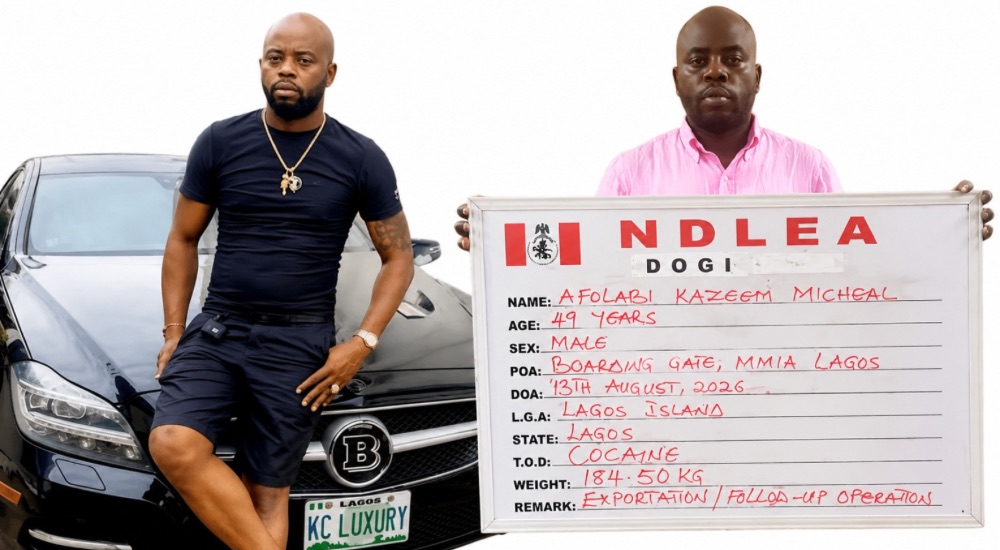
Businessman and social media influencer Afolabi Michael Kazeem, popularly known as KC Luxury, was brought to the Federal High Court in Lagos in an ambulance while receiving oxygen on Friday, as his lawyer urged the court to grant him bail to enable him to receive specialised medical treatment.
At the resumed hearing, a correctional officer informed the court that Kazeem was critically ill and had been hospitalised.
The officer told the court that the defendant had been brought to the court premises in an ambulance and proceeded to call the nurse attending to him.
A nurse from the Police Hospital, Falomo, Lagos, Bukki Yahya, told Justice Musa Kakaki that Kazeem, who was receiving oxygen inside the ambulance at the court premises, could not be moved into the courtroom because of his condition.
Yahya said the defendant was admitted to the hospital on October 7, 2026, and diagnosed with asthma and sepsis.
“My Lord, I am Bukki Yahya, the nurse attending to the patient, Afolabi. He was diagnosed with asthma and sepsis when he was brought to the Police Hospital, Falomo.
“He is inside the ambulance in the court premises, but we can’t move him here because he is with oxygen,” she said.
Following the nurse’s testimony, Kazeem’s counsel, Chief Emefo Etudo, questioned why his client had been brought to court in such a condition.
“If, for instance, the defendant was in the intensive care unit and is like this, why should they bring him to court?” he asked.
Justice Kakaki subsequently directed that the defendant be returned to the hospital, saying, “You can take him back to the hospital.”
Kazeem is standing trial alongside two other defendants, Boniface Freeman Ochoche Sule and Ikechukwu Ekugo Patriarch, over alleged cocaine trafficking involving 184.5kg of cocaine and money laundering.
After the court directed that Kazeem be returned to the hospital, Etudo proceeded to argue his client’s bail application, dated October 16, 2026.
He told the court that the application sought Kazeem’s release on bail to enable him to receive specialised medical treatment at the Lagos University Teaching Hospital (LUTH).
The lawyer said the defence had filed an affidavit of urgency, a 21-paragraph affidavit in support of the application, a written address and the relevant exhibits.
He added that the defence had also filed a reply to the prosecution’s counter-affidavit on October 22.
Etudo argued that Kazeem’s condition had deteriorated, particularly following the collapse of his lungs, which he said was disclosed by the Police Hospital, Falomo.
According to the lawyer, the police hospital transferred the defendant to LUTH because it lacked the facilities required for the surgical management of his condition.
He alleged that Kazeem was subsequently withdrawn from LUTH and taken to a correctional centre on October 13, despite his condition.
Etudo said the defendant’s condition worsened while he was being conveyed to the correctional centre, forcing those accompanying him to return him to the Police Hospital, Falomo, where he was admitted to the intensive care unit.
He urged the court to grant the bail application, arguing that the defendant’s medical condition warranted his release.
Opposing the application, prosecution counsel Abu Ibrahim said the prosecution had filed an 11-paragraph counter-affidavit, sworn to by Ebuka Okwonkwo, on October 22.
Ibrahim argued that the defence was raising issues already considered by the court in its October 2 pronouncement concerning Exhibit AK2.
He submitted that the application amounted to an attempt to relitigate an issue that should have been challenged on appeal.
The prosecutor also argued that the medical evidence presented by the defence did not sufficiently justify the defendant’s release.
“Your Lordship looked at the application. The ailment is the same. It is the same asthma. But maybe it has become acute; the character and the ailment are the same,” Ibrahim said.
He added that the defence had not presented a medical document from LUTH showing that the hospital could not manage Kazeem’s condition.
“They said he was admitted, treated and discharged. We urge your Lordship to dismiss this application,” he said.
While acknowledging that bail was at the discretion of the court, Ibrahim described Kazeem as a flight risk and urged the judge to impose stringent conditions if the application was granted.
In response, Etudo urged the court to grant bail on liberal terms, insisting that his client’s condition spoke for itself.
“The condition of the first defendant speaks for itself. We have heard what the prosecution said. We urge this court to grant this application on liberal terms,” he said.
He assured the court that Kazeem would attend subsequent proceedings if released, adding that his international passport was already in the custody of the authorities.
After hearing the parties’ arguments, Justice Kakaki adjourned ruling on the bail application until October 28, 2026.
Judiciary
$242m Petroleum Products Diversion Claim: UBA Secures Court Order Against Vitol, Four Others
The Lagos State High Court last Thursday granted interim preservative orders, including a Mareva injunction, against Vitol S.A., a Switzerland-based energy trading company, and four other shipping companies in favour of United Bank for Africa (UBA) Plc.
The bank accused Vitol of wrongfully releasing cargoes of petroleum products consigned to the order of UBA in the bills of lading.
Addressing the court, Bode Olanipekun, SAN, lead counsel for UBA, urged the court to grant the interim preservative orders against Vitol and the other shipping companies.
In a ruling on the application, the presiding judge, Justice K. A. Jose, granted three prayers in UBA’s application, including requests to restrain the dissipation of assets and dealings in funds up to the disputed amount by Vitol S.A.
“Prayers 1–3 are granted as prayed against the 2nd Respondent only,” the judge ruled.
The application was brought pursuant to Order 43, Rule 1 of the High Court of Lagos State (Civil Procedure) Rules, 2019, and the Lagos State High Court Practice Direction No. 2 of 2019.
In the substantive proceedings, UBA is seeking to establish that Vitol S.A. and the owners of the vessels are liable for alleged conversion, misrepresentation and negligence arising from the non-delivery of the petroleum products.
UBA also cited 34 financial institutions and public agencies, including commercial banks, merchant banks, microfinance banks, the Nigerian Ports Authority and the Nigeria Customs Service, in connection with the application.
In an affidavit supporting the application, UBA’s Group Head of Recoveries and Remedial Management, Anthony Chilaka, stated that the bank issued a letter of credit in favour of Vitol S.A. to facilitate a petroleum products transaction.
UBA alleged that the cargo was transported to Nigeria and that the vessels’ masters issued several bills of lading.
The bank further alleged that Vitol subsequently endorsed the bills of lading “to the order of” UBA and handed over the original copies to the bank.
UBA maintained that the endorsement entitled it to take possession of the cargo upon completion of the voyage.
However, Chilaka stated that the bank had not received the gasoil despite the completion of the voyage.
“The applicant has not been given possession of the gasoil despite completion of the voyage,” the affidavit stated.
UBA alleged that the cargo was instead put to the use of another party, contending that the respondents’ failure to deliver it amounted to conversion and negligence.
The bank argued that the respondents had obligations arising from the transaction and the endorsement of the shipping documents, which it claimed they failed to fulfil.
UBA further alleged that cargoes associated with the transactions were diverted to other parties after their respective voyages rather than delivered to the bank.



FBI Commends Olukoyede, EFCC for Support in Tackling Sextortion, Cybercrime

EFCC Photo News

Alleged ₦76bn, $31.5m Fraud: Witness Says Kuru Approved Arik Air Receivership Without Prior AMCON Board Approval

Alleged ₦1.4bn Oil Fraud: EFCC Re-Arraigns Nadabo Energy Boss, Ali Peters, Firm in Lagos

Alleged ₦1.06bn Fraud: EFCC Secures Court Order to Freeze Suspect’s Account

Again, Dangote Refinery Hikes Petrol To ₦1,175/Litre, Diesel To ₦1,620/Litre — Report
-
 EFCC7 months ago
Alleged ₦1.4bn Oil Fraud: EFCC Re-Arraigns Nadabo Energy Boss, Ali Peters, Firm in Lagos
-
 EFCC1 week ago
Alleged ₦1.06bn Fraud: EFCC Secures Court Order to Freeze Suspect’s Account
-
 News8 months ago
Again, Dangote Refinery Hikes Petrol To ₦1,175/Litre, Diesel To ₦1,620/Litre — Report
-
 News9 months ago
Senate Retains Two-Year Jail Term for PVC Trading, Raises Fine to ₦5m
-

 EFCC8 months ago
Lagos Court Jails Man 18 Months for Defrauding Sterling Bank of ₦30m
-
EFCC4 weeks ago
EFCC Hands Over Recovered ₦107m to Property Fraud Victim in Lagos
-

 Economy8 months ago
Naira Rebounds To ₦1,363.5/$
-

 Economy8 months ago
Naira Closes in the Red at ₦1,341.35/$