
Judiciary
BREAKING: Suspected Coup Plotters Remanded in DSS Custody by Court


The Federal Government, on Wednesday, arraigned six alleged masterminds of a plot to overthrow the administration of President Bola Tinubu through a coup d’état.
The defendants were docked before Justice Joyce Abdulmalik of the Federal High Court, Abuja.
Following their pleas of not guilty to the 13-count charge, the court ordered that they be remanded in the custody of the Department of State Services (DSS).
The remand order followed an application by the Attorney-General of the Federation and Minister of Justice, Prince Lateef Fagbemi, SAN, who appeared in court to personally handle the case.
The court also ordered an accelerated hearing and adjourned the matter until April 27, 2026, for the commencement of trial.
Earlier, defence counsel, led by Mohammed Ndayako, SAN, urged the court to direct the DSS to grant them access to their clients to enable adequate preparation for their defence, noting that the defendants had been in detention since their arrest.
Among those listed as defendants in the charge marked FHC/ABJ/CR/206/2026 is a former Governor of Bayelsa State and ex-Minister of State for Petroleum Resources under late President Muhammadu Buhari, Timipre Sylva.
Sylva, who is reportedly at large after allegedly leaving the country before the coup plot was uncovered, was arraigned in absentia.
The other defendants include retired Major General Mohammed Ibrahim Gana, retired Naval Captain Erasmus Ochegobia Victor, serving Police Inspector Ahmed Ibrahim, Zekeri Umoru, Bukar Kashim Goni, and Abdulkadir Sani.
The charges against the defendants border on treason, terrorism, failure to disclose security intelligence, and money laundering in furtherance of terrorism.
According to the Federal Government, the defendants, sometime in September 2025, conspired among themselves to levy war against the state in a bid to overawe President Tinubu, thereby committing an offence punishable under Section 37(2) of the Criminal Code.
They were also alleged to have had prior knowledge of a planned treasonable act involving one Colonel Mohammed Alhassan Ma’aji and others but failed to inform the appropriate authorities.
The prosecution further alleged that the defendants rendered assistance to Colonel Ma’aji by failing to disclose the plot to either the President or any peace officer, and by not taking reasonable steps to prevent its execution.
Additional charges relate to offences under the Terrorism (Prevention and Prohibition) Act, 2022, including conspiracy to commit acts of terrorism within the Federal Republic of Nigeria.
Specifically, Inspector Ahmed Ibrahim and Zekeri Umoru were accused of participating in meetings connected to terrorist activities “in a bid to further a political ideology capable of destabilising the constitutional structure of the Federal Republic of Nigeria.”
The defendants were also accused of providing support for terrorism through financial transactions linked to the alleged plot.
The prosecution alleged that Bukar Kashim Goni retained the sum of ₦50,000,000.00, believed to be proceeds of terrorism financing, while Abdulkadir Sani allegedly retained ₦2,000,000.00 from a similar source.
Zekeri Umoru was accused of accepting a cash payment of ₦10,000,000.00 without going through a financial institution and retaining an additional ₦8,800,000.00 suspected to be proceeds of terrorism financing.
Similarly, Inspector Ahmed Ibrahim was alleged to have taken possession of ₦1,000,000.00 linked to the same scheme.
All financial-related counts were brought under the Money Laundering (Prevention and Prohibition) Act, 2022.
At the sitting, which commenced at about 1:46 p.m., the Attorney-General informed the court that the charge was ready and sought leave to have it read to the defendants.
Proceedings were briefly stalled after the third defendant informed the court that his counsel was indisposed, while counsel to the sixth defendant stated that his client understood only Arabic and Hausa, prompting the court to stand down the matter to secure an interpreter.
When the court reconvened at about 2:18 p.m., all six defendants took their pleas and denied the allegations.
Following the arraignment, the prosecution applied for their remand in DSS custody and requested an accelerated hearing. The request was not opposed by most defence counsel, although counsel to the first defendant indicated an intention to file a bail application.
In her ruling, Justice Abdulmalik ordered that the defendants be remanded in DSS custody with access to their lawyers and adjourned the matter until April 27, 2026, for the commencement of trial.
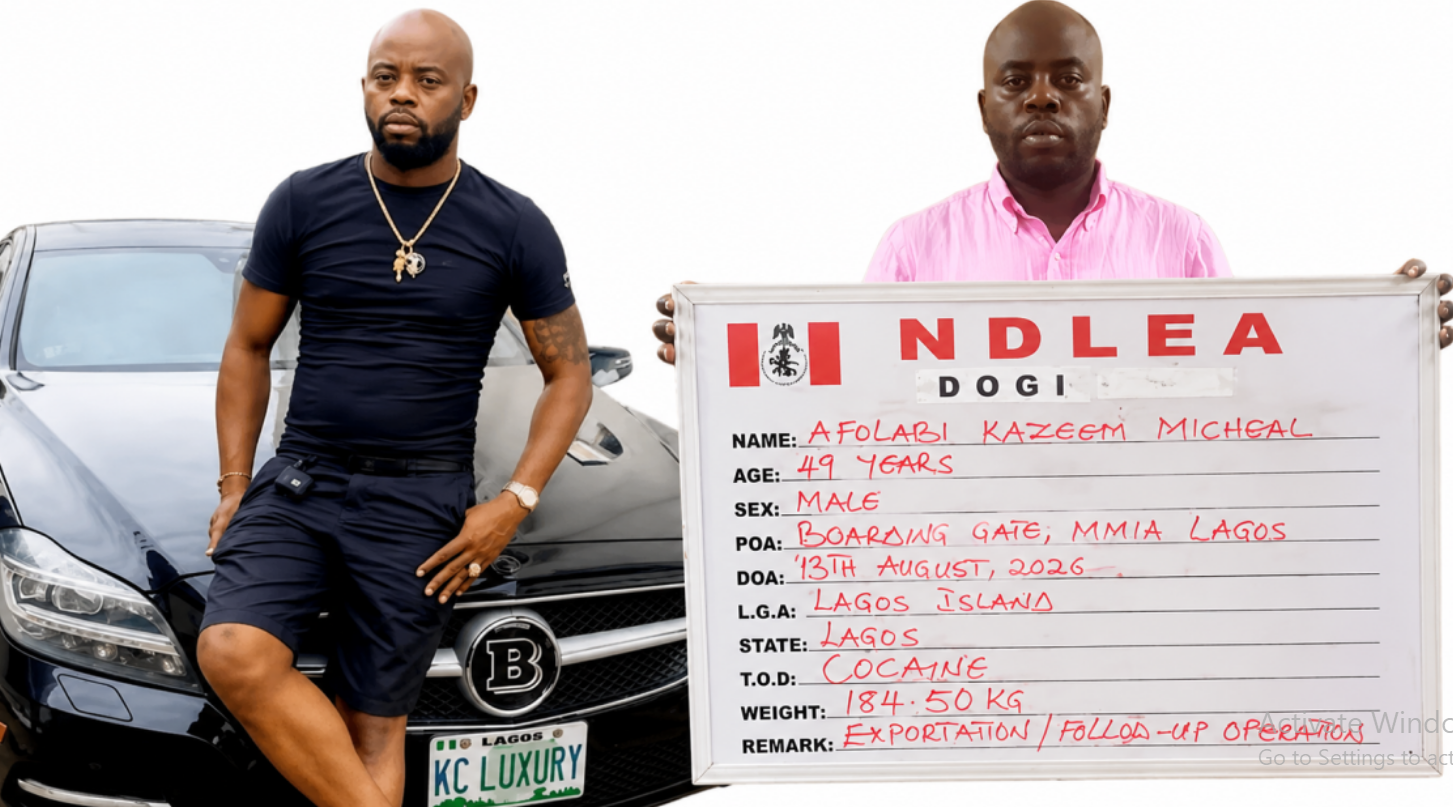
Businessman and social media influencer Afolabi Michael Kazeem, popularly known as KC Luxury, who is standing trial over alleged 184.5kg cocaine trafficking and money laundering, has asked Justice Musa Kakaki of the Federal High Court in Lagos to recuse himself from the case, citing alleged irregularities in court records and concerns about his health.
The application followed the court’s refusal last Wednesday to grant Kazeem bail on medical grounds. The judge held that the defendant had failed to establish special circumstances or provide sufficient evidence to justify his release.
At the resumed proceedings on Monday, Kazeem, who was absent from court, sought the judge’s recusal through his counsel, Chief Emefo Etudo, who appeared alongside Mrs Charity Etudo.
Etudo told the court that the record of proceedings did not reflect the ruling delivered on October 28, 2026, on his client’s bail application. He added that repeated efforts to obtain a copy of the ruling from the court registry had proved unsuccessful.
He said the defence had been informed that the judge had yet to sign the ruling, raising concerns that the delay could affect his client’s right to appeal within the prescribed period.
Etudo also alleged that a reply affidavit filed by the defence had gone missing, questioning the safety of documents submitted to the court.
“The record of proceedings did not reflect that any ruling was made on October 28, 2026, by this honourable court. And we don’t feel so safe that our evidence, like the reply affidavit that got missing, is safe in the court,” he said.
Etudo further criticised the Federal High Court’s lack of adequate recording facilities, arguing that verbatim recording equipment would ensure that statements and decisions made during proceedings were accurately captured.
He maintained that the discrepancies in the court records had further eroded his client’s confidence in the court.
Etudo also questioned the prosecution’s evidence, insisting that the documents presented before the court did not establish a connection between the first, second and third defendants and the alleged offences.
He said he intended to file a separate application challenging the sufficiency of the evidence but wanted the court to determine the recusal application first.
Opposing the request to take the application immediately, prosecution counsel Ibrahim Abu argued that the matter was scheduled for trial and that the defence had not explained the first defendant’s absence.
“I thought what Chief Etudo would have begun with was to address the business of the day, which is trial. Etudo has not explained to the court where his client is. That is where he should have begun from,” Abu said.
He told the court that the prosecution had six witnesses in attendance and was ready to commence the trial, as previously directed.
Abu, who said he was served with the application during the court’s stand-down, argued that it was not ripe for hearing and requested five days to respond instead of the seven days ordinarily allowed under the rules.
Opposing the application, Abu described allegations of judicial bias as serious and maintained that the court had been fair to all parties.
He argued that the trial had not commenced and that the refusal of a bail application could not, on its own, establish bias on the part of the court.
He said the defence had the option of appealing the bail decision or filing another application.
“Refusal of bail is the discretion of the court. That is not bias. There is an opportunity to appeal the decision, which has not been taken,” he said.
The prosecution also opposed the suggestion to sever the charges, arguing that the first count alleged a conspiracy involving the defendants.
Counsel to the second defendant, Augustine Audu (SAN), confirmed that his client had also been served with the application during the stand-down. He, however, urged the court to hear and determine it before proceeding with the trial.
Audu argued that the pending application had stalled proceedings and undermined the purpose of the order for an accelerated hearing.
He also urged the prosecution to amend the charge and separate the defendants to enable the second and third defendants to proceed with their trial independently of the first defendant.
“We do not want the fate of the second and third defendants to be tied to the first defendant, because we are stuck,” he said.
The senior advocate maintained that the conspiracy count did not prevent the prosecution from proceeding against some defendants while others were at large.
“The fate of the second and third defendants cannot be left hanging. The first count is conspiracy, and people can be tried while others are at large,” he argued.
He further urged the court to consider bail for the second and third defendants, insisting that they should not remain in custody while the first defendant’s application stalled the trial.
Audu said his client was eager to face trial and clear his name, adding that the second defendant should not be made to bear the consequences of proceedings involving another defendant.
He also said he would not oppose the recusal application, noting that it concerned the first defendant and the prosecution.
Audu added that his client was languishing in custody despite being presumed innocent.
Responding, Etudo said he had reluctantly filed the recusal application because his client had lost confidence in the court.
“My client has lost confidence in this court, and that is why I have had to bring this application, although I was reluctant to do so,” Etudo said.
He disclosed that Kazeem’s health had deteriorated and challenged the prosecution to verify his condition.
Etudo recounted a previous case at the Ikeja High Court in which he had sought the release of a client suffering from prostate cancer to enable him to receive medical treatment.
According to him, the court refused the application, and the defendant died before the next adjourned date.
Etudo said the experience informed his concerns about Kazeem’s deteriorating health and the consequences of keeping him in custody.
He maintained that his client was in a sorry state and no longer had confidence in the court.
The prosecution maintained its readiness to proceed with the trial but requested five days to respond to the recusal application.
Justice Kakaki adjourned the case until November 25, 2026, for the hearing of submissions on the application.
Judiciary
Alleged ₦76bn, $31.5m Fraud: Witness Says Kuru Approved Arik Air Receivership Without Prior AMCON Board Approval

The trial of a former Managing Director and Chief Executive Officer of the Asset Management Corporation of Nigeria (AMCON), Ahmed Kuru, and four others over an alleged ₦76 billion and $31.5 million fraud continued on Monday, October 26, 2026, with the fourth prosecution witness (PW4), Bawa Usman Kaltungo, telling Justice Mojisola Dada of the Special Offences Court sitting in Ikeja, Lagos, that Kuru approved the receivership of Arik Air without obtaining prior approval from AMCON’s Board.
Kuru, alongside Kamilu Alaba Omokide, Roy Ilegbodu, Union Bank of Nigeria Plc and Super Bravo Limited, is being prosecuted by the Economic and Financial Crimes Commission (EFCC) on a six-count charge bordering on conspiracy, stealing and abuse of office.
One of the counts reads: “That you, Union Bank Nigeria Plc, sometime in 2011 or thereabouts, in Lagos, within the jurisdiction of this Honourable Court, with the intention of causing and/or inducing the unwarranted sale of Arik Air loans and bank guarantees with Union Bank, made false statements to the Asset Management Corporation of Nigeria (AMCON) regarding Arik Air Limited’s performing loans, following which you transferred a bogus figure of ₦71,000,000,000.00 (Seventy-One Billion Naira) to AMCON.”
Another count reads: “That you, Ahmed Lawal Kuru, Kamilu Alaba Omokide, as Receiver Manager of Arik Air Limited, and Captain Roy Ilegbodu, Chief Executive Officer of Arik Air Limited in Receivership, sometime in 2022 or thereabouts, in Lagos, within the jurisdiction of this Honourable Court, fraudulently converted to the use of NG Eagle Limited the sum of ₦4,900,000,000.00 (Four Billion, Nine Hundred Million Naira), property of Arik Air Limited.”
During cross-examination by Uyi Giwa-Osagie, counsel to Kuru, at the resumed hearing on Monday, Kaltungo, who is currently the Acting Zonal Director of the EFCC’s Lagos Zonal Directorate 2, maintained that Kuru, as AMCON’s Managing Director and Chief Executive Officer, exercised extensive powers within the Corporation and approved the receivership arrangement without first obtaining the Board’s approval.
Kaltungo, a former Head of the AMCON Desk when the investigation commenced, told the court that investigations revealed that a receiver-manager was appointed for Arik Air before the matter was presented to AMCON’s Board for approval. He added that the appointments went beyond what the Board subsequently approved.
Kaltungo further told the court that investigators requested documents linking the appointment of the receiver-manager to a prior decision of AMCON’s Board, but the documents were not produced during the investigation.
The witness explained that the EFCC’s investigation was initiated following a petition written by counsel to Arik Air’s directors and shareholders, Femi Falana, SAN, and addressed to the EFCC Chairman.
When presented with a copy of the petition, the witness identified it as the document received by the Commission.
He told the court that “the petition was dated April 27, 2023, received by the office of the EFCC Chairman on May 3, 2023, and forwarded to the Director of Operations on May 12, 2023.”
He further testified that on May 22, 2023, the Commission directed the then Head of the AMCON Desk to investigate the allegations.
Kaltungo said he supervised the investigation alongside other investigators and conducted interviews with persons considered relevant to the matter.
According to him, the AMCON Desk was responsible for investigating cases referred to it involving AMCON, among other matters, adding that “other desks also investigate AMCON-related cases.”
He further testified that the EFCC’s investigation focused on individuals whose actions were relevant to the matter rather than specifically on the positions they held.
He told the court that the investigation report tendered in evidence contained the EFCC’s findings based on the information and evidence available to the Commission at the conclusion of the investigation.
Addressing the circumstances surrounding the receivership, Kaltungo said investigators sought to establish how AMCON came to appoint a receiver-manager for Arik Air.
According to him, those responsible for the appointment explained that the airline had an outstanding bad loan.
He said, however, that the investigation found the claim underlying the receivership arrangement to be false.
“The evidence gathered by the Commission did not establish that the Nigerian government had paid money to acquire Arik Air or its debt,” he said.
He added that a receiver-manager was expected to take control of a company placed under receivership and protect and preserve its assets.
Kaltungo also stated that although AMCON had the power to appoint a receiver for an indebted company, such power had to be exercised in accordance with due process.
He further told the court that the investigation was not limited to the appointment of the receiver-manager but also covered other allegations contained in the petition.
He identified Oluseye Opasanya, SAN, and Kamilu Alaba Omokide, the second defendant in the case, as the two individuals who had served as receiver-managers of Arik Air.
“Opasanya ceased to be the receiver-manager in 2019, while Omokide was the receiver-manager at the time of the investigation,” he said.
When confronted by counsel to the first defendant with a document relating to Omokide’s appointment, Kaltungo observed that the copy presented to him was incomplete and had emanated from the Corporate Affairs Commission rather than AMCON.
He requested the deed of appointment issued by AMCON, which he said had been submitted to the court as an exhibit.
He also told the court that the individuals named in the petition worked under the receiver-manager and that responsibility for their actions could arise in the circumstances of the case.
Responding to questions about AMCON’s role in the transaction, the witness maintained that the Corporation had been defrauded by Union Bank of Nigeria Plc over the alleged sale of Arik Air’s loans and bank guarantees.
He further stated that the investigation did not establish that AMCON had paid money to acquire Arik Air or its debt, adding that the Commission’s findings indicated that the Corporation had been misled into taking over what was presented as bad debt.
The court also heard arguments from the prosecution and defence counsel over documents containing resolutions of AMCON’s Board concerning the receivership.
Prosecution counsel, Wahab Shittu, SAN, argued that the central issue was whether AMCON’s Board had approved the appointment of a receiver-manager before the action was taken.
Shittu referred to documents tendered by the defence, including a Board resolution dated July 18, 2019, and other documents dated between two and five years after the receivership decision.
He argued that the documents were too remote from the decision under investigation to establish that the necessary approval had been obtained before the appointment.
Shittu maintained that the relevant Board approval ought to have been secured before the appointment or within a reasonable time, rather than two to five years after the decision had been made.
In response, Giwa-Osagie argued that the charges against his client related to the appointment of the receiver-manager and contended that the decisions in question had been made by AMCON’s Board.
He further argued that his client was the only Board member being prosecuted over the decisions.
In his response, Shittu clarified that the prosecution was not arguing that the documents were irrelevant but that they were too remote to establish prior approval for the decision being challenged.
Subsequently, counsel representing the second, third, fourth and fifth defendants stated that they had no objections to the seven documents tendered by counsel to the first defendant.
Justice Dada subsequently admitted the documents containing AMCON Board resolutions in evidence after hearing arguments from the prosecution and defence counsel.
The case was adjourned until Tuesday, October 27, 2026, for continuation of the trial.
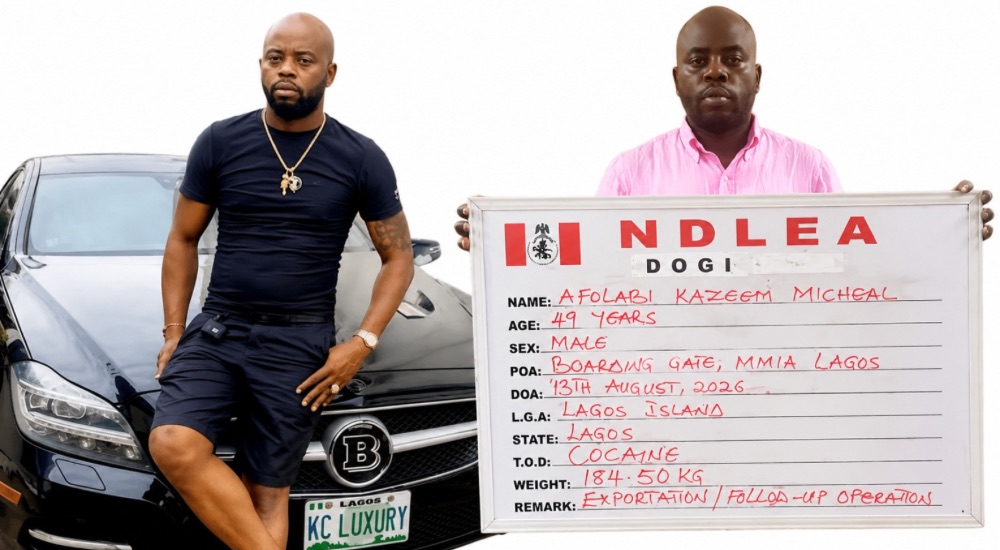
Businessman and social media influencer Afolabi Michael Kazeem, popularly known as KC Luxury, was brought to the Federal High Court in Lagos in an ambulance while receiving oxygen on Friday, as his lawyer urged the court to grant him bail to enable him to receive specialised medical treatment.
At the resumed hearing, a correctional officer informed the court that Kazeem was critically ill and had been hospitalised.
The officer told the court that the defendant had been brought to the court premises in an ambulance and proceeded to call the nurse attending to him.
A nurse from the Police Hospital, Falomo, Lagos, Bukki Yahya, told Justice Musa Kakaki that Kazeem, who was receiving oxygen inside the ambulance at the court premises, could not be moved into the courtroom because of his condition.
Yahya said the defendant was admitted to the hospital on October 7, 2026, and diagnosed with asthma and sepsis.
“My Lord, I am Bukki Yahya, the nurse attending to the patient, Afolabi. He was diagnosed with asthma and sepsis when he was brought to the Police Hospital, Falomo.
“He is inside the ambulance in the court premises, but we can’t move him here because he is with oxygen,” she said.
Following the nurse’s testimony, Kazeem’s counsel, Chief Emefo Etudo, questioned why his client had been brought to court in such a condition.
“If, for instance, the defendant was in the intensive care unit and is like this, why should they bring him to court?” he asked.
Justice Kakaki subsequently directed that the defendant be returned to the hospital, saying, “You can take him back to the hospital.”
Kazeem is standing trial alongside two other defendants, Boniface Freeman Ochoche Sule and Ikechukwu Ekugo Patriarch, over alleged cocaine trafficking involving 184.5kg of cocaine and money laundering.
After the court directed that Kazeem be returned to the hospital, Etudo proceeded to argue his client’s bail application, dated October 16, 2026.
He told the court that the application sought Kazeem’s release on bail to enable him to receive specialised medical treatment at the Lagos University Teaching Hospital (LUTH).
The lawyer said the defence had filed an affidavit of urgency, a 21-paragraph affidavit in support of the application, a written address and the relevant exhibits.
He added that the defence had also filed a reply to the prosecution’s counter-affidavit on October 22.
Etudo argued that Kazeem’s condition had deteriorated, particularly following the collapse of his lungs, which he said was disclosed by the Police Hospital, Falomo.
According to the lawyer, the police hospital transferred the defendant to LUTH because it lacked the facilities required for the surgical management of his condition.
He alleged that Kazeem was subsequently withdrawn from LUTH and taken to a correctional centre on October 13, despite his condition.
Etudo said the defendant’s condition worsened while he was being conveyed to the correctional centre, forcing those accompanying him to return him to the Police Hospital, Falomo, where he was admitted to the intensive care unit.
He urged the court to grant the bail application, arguing that the defendant’s medical condition warranted his release.
Opposing the application, prosecution counsel Abu Ibrahim said the prosecution had filed an 11-paragraph counter-affidavit, sworn to by Ebuka Okwonkwo, on October 22.
Ibrahim argued that the defence was raising issues already considered by the court in its October 2 pronouncement concerning Exhibit AK2.
He submitted that the application amounted to an attempt to relitigate an issue that should have been challenged on appeal.
The prosecutor also argued that the medical evidence presented by the defence did not sufficiently justify the defendant’s release.
“Your Lordship looked at the application. The ailment is the same. It is the same asthma. But maybe it has become acute; the character and the ailment are the same,” Ibrahim said.
He added that the defence had not presented a medical document from LUTH showing that the hospital could not manage Kazeem’s condition.
“They said he was admitted, treated and discharged. We urge your Lordship to dismiss this application,” he said.
While acknowledging that bail was at the discretion of the court, Ibrahim described Kazeem as a flight risk and urged the judge to impose stringent conditions if the application was granted.
In response, Etudo urged the court to grant bail on liberal terms, insisting that his client’s condition spoke for itself.
“The condition of the first defendant speaks for itself. We have heard what the prosecution said. We urge this court to grant this application on liberal terms,” he said.
He assured the court that Kazeem would attend subsequent proceedings if released, adding that his international passport was already in the custody of the authorities.
After hearing the parties’ arguments, Justice Kakaki adjourned ruling on the bail application until October 28, 2026.



EFCC Uncovers Chinese-Operated Illegal Oil Refinery in Ogun

EFCC Counsel Misquoted in ALGON Lawyer’s Fraud Allegation Judgment

KC Luxury Seeks Judge’s Recusal Over Missing Bail Ruling

Alleged ₦1.4bn Oil Fraud: EFCC Re-Arraigns Nadabo Energy Boss, Ali Peters, Firm in Lagos

Alleged ₦1.06bn Fraud: EFCC Secures Court Order to Freeze Suspect’s Account

Again, Dangote Refinery Hikes Petrol To ₦1,175/Litre, Diesel To ₦1,620/Litre — Report
-
 EFCC7 months ago
Alleged ₦1.4bn Oil Fraud: EFCC Re-Arraigns Nadabo Energy Boss, Ali Peters, Firm in Lagos
-
 EFCC2 weeks ago
Alleged ₦1.06bn Fraud: EFCC Secures Court Order to Freeze Suspect’s Account
-
 News8 months ago
Again, Dangote Refinery Hikes Petrol To ₦1,175/Litre, Diesel To ₦1,620/Litre — Report
-
EFCC4 weeks ago
EFCC Hands Over Recovered ₦107m to Property Fraud Victim in Lagos
-
 News9 months ago
Senate Retains Two-Year Jail Term for PVC Trading, Raises Fine to ₦5m
-

 EFCC8 months ago
Lagos Court Jails Man 18 Months for Defrauding Sterling Bank of ₦30m
-

 Economy8 months ago
Naira Rebounds To ₦1,363.5/$
-

 Economy9 months ago
Naira Closes in the Red at ₦1,341.35/$