
EFCC
BREAKING: Court Grants Final Forfeiture of $13m Linked to Achimugu’s Firm


Justice Emeka Nwite of the Federal High Court in Abuja, on Wednesday, March 25, 2026, granted an order of final forfeiture of the sum of $13 million linked to businesswoman Aisha Achimugu and her company, Oceangate Engineering Oil & Gas Ltd.
The Economic and Financial Crimes Commission (EFCC) had brought Oceangate Engineering Oil & Gas Ltd before the court over the ownership of the $13 million, suspected to be proceeds of fraud and unlawful activities.
Delivering judgment in a suit instituted by Oceangate Engineering Oil & Gas Ltd to claim the funds, Justice Nwite held that the company failed woefully to establish how it came into possession of the money. He, however, stressed that the EFCC succeeded in convincing the court that the funds were proceeds of fraud and should be forfeited to the government.
The judge dismissed claims that the $13 million constituted gifts received by the company through Aisha Achimugu, noting that she never appeared in court to show cause why the funds should not be forfeited to the Federal Government.
Additionally, Justice Nwite stated that no individual who allegedly gave monetary gifts to Achimugu—amounting to $13 million—was called to testify.
The court held that the burden of proving legitimate ownership of the funds was not discharged by the applicant to counter the EFCC’s claim that the money was proceeds of fraud based on its investigation.
According to the judge, Oceangate Engineering did not demonstrate any business activity that generated the funds, nor did it show evidence of payments from any customer.
Justice Nwite had earlier, on August 22, 2025, granted the EFCC an interim forfeiture order on the $13 million linked to Oceangate. He also directed the commission to publish the order in a national daily, inviting interested parties to show cause within 14 days why the funds should not be permanently forfeited to the government.
Justifying the forfeiture, EFCC investigator Usman Aliyu swore to an affidavit stating that the commission acted on intelligence indicating that Oceangate Engineering Limited, without due process, used funds reasonably suspected to be proceeds of unlawful activity to acquire oil blocks from the Nigerian Upstream Petroleum Regulatory Commission (NUPRC).
Aliyu maintained that the $13 million used by Oceangate to pay signature bonuses for PPL 302 and PPL 3007 were not proceeds of any lawful business but rather funds suspected to be derived from unlawful activities.
He further stated that part of the funds used by Oceangate to pay the signature bonuses was sourced from large sums transferred by a state government to contractors for the execution of projects.
The investigator alleged that there were no contractual or business relationships between Oceangate and the contractors who transferred the public funds into the company’s account.
He added that the contractors were neither investors, directors, nor shareholders in Oceangate.
However, in its affidavit, Oceangate urged the court not to grant the final forfeiture order, arguing that the funds were derived partly from legitimate business earnings and partly from gifts given to its Group Chief Executive Officer, Aisha Achimugu.
In response, the EFCC urged the court to dismiss the application.
Aliyu further deposed that Iliya Wakil, who swore to Oceangate’s affidavit, was merely a nominal director with no shareholding in the company.
He stated that Wakil was an employee of Felak Concept Group Limited, also owned by Achimugu, and incorporated on May 5, 2000.
According to Aliyu, Wakil admitted in his extrajudicial statement on April 15, 2025, that he had worked with Felak Concept since 2000 and had held several positions, including Manager (Admin), General Manager (Admin and Finance), and currently Group General Manager (Admin and Finance).
He added that Wakil confirmed he received his salary from Felak Concept and WishWhich Koncept Limited, with no record of receiving any salary from Oceangate.
Aliyu also stated that Wakil admitted receiving instructions directly from Achimugu, which he relayed to another individual, Mr. Chiroma, via telephone.
The investigator described Oceangate as “a briefcase/shell company created as a vehicle for holding petroleum-related assets procured with funds reasonably suspected to be proceeds of unlawful activity.”
“Hence, describing the company as ‘a professional oil and gas consortium operating in diverse sectors of the Nigerian economy’ is nothing but describing the devil as an angel of light,” Aliyu stated.
He alleged that the modus operandi of Oceangate was to acquire petroleum-related assets using tainted funds.

The Executive Chairman of the Economic and Financial Crimes Commission (EFCC), Mr. Ola Olukoyede, on Thursday, July 30, 2026, cautioned public officials across the country against fraudulent practices, stressing that public service is a responsibility to protect public resources rather than an opportunity for self-enrichment or compromise.
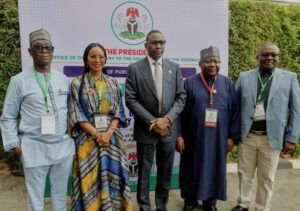
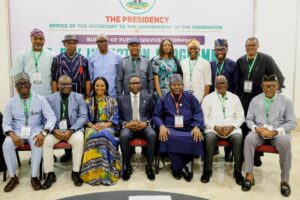
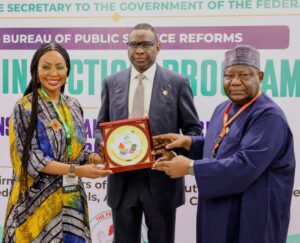
He gave the caution in Abuja on Thursday, July 30, 2026, while speaking at a two-day induction programme organised by the Bureau of Public Service Reforms.
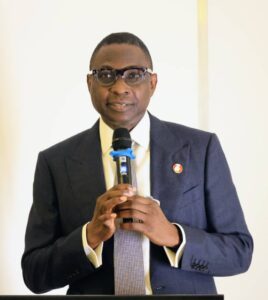
The programme, themed “Institutional Governance and Regulatory Compliance,” was organised for the Chairman, Chief Executive Officer (CEO), and members of the Governing Board of the South-South Development Commission (SSDC).
Speaking on “The Role of the Economic and Financial Crimes Commission (EFCC) in Improving Accountability in the Public Service,” the EFCC Chairman said accountability requires that public resources be managed ethically, efficiently, and in the best interest of citizens. He, however, noted that corruption has continued to frustrate the prudent management of government resources in Nigeria.
“Annual losses to corruption in Nigeria’s public service run into billions of naira, as resources meant for the provision of physical infrastructure and social services are often converted to private use by public servants,” he said.
Olukoyede identified common forms of corruption in the public service as outright theft from the treasury, diversion of public funds, bribery and kickbacks, misappropriation of funds, procurement and contract fraud, payroll and pension fraud, as well as duty tour allowance fraud.
Drawing from his experience in regulatory compliance, he described contract fraud as the most prevalent form of corruption in the public sector.
“From my experience in regulatory compliance, by far the most common form of corruption within the public service space is contract fraud, where those who lead government establishments set out to enrich themselves by rigging the procurement process.”
According to him, contract fraud often manifests through contract splitting to evade approval limits, bid manipulation in favour of preferred contractors or entities in which public officials have interests, the award of contracts to unqualified companies, and payments for poorly executed or unexecuted contracts.
Recalling the rationale behind the establishment of the EFCC, Olukoyede said the Commission was established in 2003 to combat corruption and other economic and financial crimes in both the public and private sectors through investigation, prosecution, asset recovery, and public education.
He identified limited resources and manpower, inadequate public support, widespread cynicism, delays in prosecuting high-profile corruption cases, and persistent but largely unsubstantiated allegations of selective investigations as some of the challenges confronting the anti-corruption fight.
Addressing participants directly, the anti-graft czar urged them to resist the temptation to view their appointments as opportunities for personal enrichment.
“I imagine that you all have been receiving tons of congratulatory messages on your appointments, and those close to you would have reminded you that this is an opportunity to grab a slice of the proverbial national cake. Please tread with caution. Public service is not an invitation to loot the treasury.”
He advised the officials to familiarise themselves with the Financial Regulations, Public Service Rules, and the Public Procurement Act, ensuring strict compliance with all extant regulations to avoid investigation and prosecution for corruption-related offences.
Olukoyede further warned them against engaging in businesses incompatible with public office, operating foreign bank accounts, seeking contracts from the institutions they serve either directly or through proxies, and conducting financial transactions outside recognised financial institutions.
“As a member of the SSDC, familiarise yourself with the Public Procurement Act and be guided. You should not be jostling for contracts from the SSDC either directly or through fronts,” he said.
He also encouraged the officials to maintain proper records of all financial transactions and exercise caution before endorsing official documents.
“Before you sign that document, study it. Your signature is your name and integrity. Guard it,” he said.
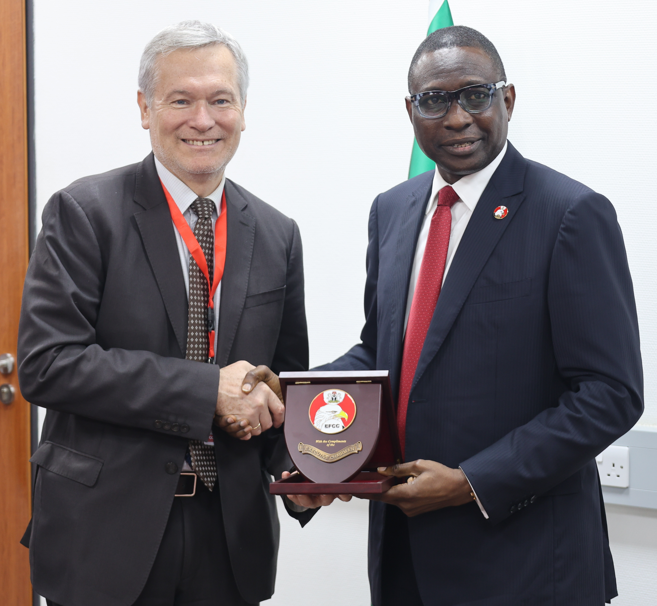
The European Union (EU) has reaffirmed its commitment to strengthening its partnership with the Economic and Financial Crimes Commission (EFCC), particularly in the areas of anti-corruption, cybercrime, training, and financial crime investigation and prosecution.
EU Ambassador to Nigeria, Gautier Mignot, stated this in Abuja on Tuesday, July 28, 2026, when he led a delegation on a courtesy visit to the corporate headquarters of the EFCC.
Stressing the strategic importance of the EFCC and the basis for the partnership with the Commission, he stated:
“The role of the EFCC is so important for us, both for the stability and prosperity of Nigeria and for our partnership, to be able to tell our potential investors: ‘You can safely come to Nigeria. There is a compliant business environment because you have strong institutions like the EFCC to make sure that this is the place.'”
Mignot expressed satisfaction with the longstanding partnership between the EU and the EFCC, which he said had existed since the establishment of the Commission, noting that the relationship had continued over the years, particularly through the Rule of Law and Anti-Corruption (RoLAC) Programme.
He assured that the EU remained committed to continuing the partnership and supporting efforts to strengthen the institutional capacity of the EFCC, improve investigative effectiveness, and enhance prosecution.
“We are very much committed to continuing this partnership, doing whatever we can do to strengthen the institution, improve investigative effectiveness, and prosecution,” he said.
He further stressed that the EU had ongoing initiatives aimed at supporting the fight against cybercrime, describing the issue as a priority for the EFCC in view of its growing prevalence. To further strengthen this effort, he disclosed that the EU had proposed training for EFCC personnel on the Cybercrime Response Centre, with the modalities of the training still being worked out.
He added that the EU was also strengthening its support for Anti-Money Laundering and Countering the Financing of Terrorism (AML/CFT) compliance while congratulating the EFCC on its efforts in the fight against corruption and cybercrime.
He said the visit was taking place at a very important moment in the EU-Nigeria partnership, stressing that the EU, alongside its 14 member states, remains a major trading, investment, and development partner of Nigeria.
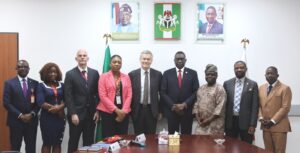
According to him, the EU is committed to deepening its partnership with Africa and leveraging greater private investment, particularly by mobilizing European companies to partner with Nigerian businesses to develop local manufacturing value chains and other sectors, including agriculture.
“Governance issues remain a core priority for us, also as an enabler for investment and for the operations of EU companies,” he said.
The Ambassador noted that European companies are particularly attentive to the business environment and compliance issues, stressing that the role of the EFCC is therefore important to the stability and prosperity of Nigeria, as well as to the EU-Nigeria partnership. He expressed optimism that the existence of strong institutions such as the EFCC would give potential European investors confidence to do business in Nigeria.
Responding, the Executive Chairman of the EFCC, Mr. Ola Olukoyede, described the Commission as Nigeria’s foremost anti-corruption agency, responsible for coordinating the investigation and prosecution of financial crimes in the country.
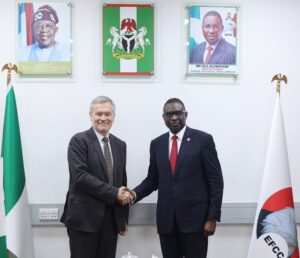
Olukoyede said the Commission had, over the years, continued to work towards ridding the country of economic and financial crimes, noting that it had recently recorded significant progress in the fight against cybercrime and terrorism financing.
“Over the years, we have strived to ensure that the country is rid of economic and financial crimes. Recently, we recorded a modest achievement in the fight against cybercrime and terrorism financing. We were taken off the grey list of the Financial Action Task Force (FATF), and we are looking forward to doing more,” he said.
The EFCC Chairman recalled that while appearing before the National Assembly during his screening and confirmation process, he had assured Nigerians that he would use his position and the instrumentality of the anti-corruption fight to stimulate the economy and attract investment into the country.
He said the Commission’s anti-corruption mandate was not only about investigating and prosecuting financial crimes but also about creating an environment where legitimate businesses and investments could thrive.
Olukoyede explained that the proposed Cybercrime Response Centre was part of efforts to protect investments and strengthen the country’s response to cybercrime.
He said the Centre, when fully operational, would operate 24 hours a day, seven days a week, with the capacity to respond to reports in real time, gather intelligence, process petitions, and act on relevant information.
“The essence of the Centre is to handle real-time reports, gather intelligence, respond to petitions, process information, and all of that,” he said.
Olukoyede assured the EU Ambassador and European countries of the Commission’s readiness to support legitimate investors and protect the business environment from the threats posed by economic and financial crimes.
“Rest assured that we are here to support all EU countries, particularly their investors,” he said.

Former Ekiti Central Senator, Babafemi Ojudu, has raised concerns over the growing influence of internet fraud on Nigeria’s social and economic landscape, warning that the recent decline in business activities across Ado Ekiti following intensified operations by the Economic and Financial Crimes Commission (EFCC) has exposed the dangers of an economy built around illicit wealth.
In a commentary titled “When Crime Becomes an Economy: The Disturbing Lessons from Ado Ekiti’s Near-Empty Hotels,” Ojudu said the near-empty hotels, deserted lounges, quiet supermarkets, and struggling businesses reported across Ekiti State, particularly in the state capital, were linked to the flight of suspected internet fraudsters, popularly known as “Yahoo boys,” following the establishment of a stronger EFCC presence in the state.
According to the former lawmaker, the development has revealed the extent to which the proceeds of cybercrime have become woven into the fabric of the local economy.
Ojudu said he was initially skeptical about reports of declining commercial activities in Ado Ekiti until he personally visited some of the affected businesses.
“The stories were true,” he wrote, recounting how he visited the restaurant of a prominent hotel overlooking its swimming pool, where he spent almost an hour as the only customer.
He added that a visit to one of the city’s popular lounges revealed a similar situation, with empty spaces replacing the bustling atmosphere that once characterized such entertainment centers.
The former senator noted that hotel operators, lounge owners, traders, landlords, mechanics, and used-car dealers had all begun feeling the impact of the sudden disappearance of big spenders suspected to be involved in internet fraud.
He said many suspected cybercriminals had reportedly relocated from Ekiti to cities such as Akure, Osogbo, Ibadan, and Lagos following intensified EFCC operations.
Ojudu linked the crackdown to the leadership of EFCC Chairman Ola Olukoyede, an Ekiti indigene, who, he said, had strengthened the Commission’s operational presence in the state in response to concerns over the growing reputation of some communities as hubs for internet fraud.
He said EFCC operatives had embarked on regular raids, arresting suspects and recovering luxury vehicles, expensive mobile devices, and other alleged proceeds of crime.
The former Ekiti Central lawmaker also highlighted the reaction of some residents to the anti-fraud campaign, citing reports of protests in Ikere Ekiti by parents and sympathizers who directed their grievances at both the traditional ruler and the EFCC Chairman.
He said the development showed the extent to which some communities had become economically dependent on the activities of suspected fraudsters.
Beyond the economic consequences, Ojudu expressed concern over what he described as a deeper moral crisis facing Nigerian society, particularly among young people.
He lamented that the traditional pursuit of professions such as medicine, law, engineering, teaching, and other fields was gradually being replaced by an obsession with quick wealth.
According to him, some young Nigerians now see internet fraud as a desirable career path, with teenagers allegedly becoming involved at very young ages and acquiring luxury lifestyles that project the proceeds of crime as symbols of success.
He criticized what he described as society’s growing tolerance for unexplained wealth, arguing that some families and communities now celebrate sudden riches without questioning their sources.
Ojudu warned that universities and other social institutions were also being affected, as some young people increasingly prioritize material displays over academic achievement and personal development.
He argued that the danger was not only the financial harm caused by cybercrime but also the long-term damage to Nigeria’s values and institutions.
“These boys and girls will not remain boys and girls forever. They will become our business leaders, our bankers, our civil servants, our judges, our lawmakers, our commissioners, our governors, and perhaps even our presidents,” he warned.
The former senator cautioned that a society that rewards criminality risks producing future leaders shaped by dishonest practices.
He concluded that while empty hotels and struggling businesses could recover with time, rebuilding a generation’s understanding of integrity, hard work, and responsible success would be a far greater challenge.
“Civilizations do not collapse only because their economies fail. They collapse when they lose the ability to distinguish honour from disgrace, industry from theft, and success from plunder,” Ojudu stated.



BREAKING: Court Jails Chinese Nationals, Sentences Them to 50 Years for Illegal Export of Nigeria’s Lithium, Copper Minerals

Court Jails Yahoo Boys’ Middleman, Four Men for Money Laundering, Illegal Forex Trading

Agidingbi Land Row: Family Accuses OORBDA of Defying Supreme Court Judgment

Dangote Refinery to deploy 4,000 gas‑powered trucks for distribution
Nigerian nurses stage seven‑day warning strike over pay, staffing

Sean Kingston sentenced to 3½ years in prison over $1 million fraud
-
Health1 year ago
Nigerian nurses stage seven‑day warning strike over pay, staffing
-
Energy12 months ago
Dangote Refinery to deploy 4,000 gas‑powered trucks for distribution
-
Entertainment12 months ago
Sean Kingston sentenced to 3½ years in prison over $1 million fraud
-
 Education1 year ago
JAMB sets 2025/26 university cut‑off at 150, bars under‑16
-
 Economy12 months ago
Nigeria approves plan to refinance ₦4tn power-sector debt
-
 Crime & Justice6 months ago
BREAKING: Two Chinese Directors Jailed 46 Years Each Over ₦3.4bn, $2.5m Crypto Fraud in Lagos
-

 Business6 months ago
Nigeria Revenue Service Collects ₦28.3trn in 2025, Sets ₦40.7trn Target for 2026
-

 Crime & Justice6 months ago
Police Arrest 24-Year-Old Over ₦48.5m Romance Fraud in Lagos