
Judiciary
Court Urges Settlement in ₦98.5bn Patent Suit Against CBN, NIBSS Over Cash Management Technology


A Federal High Court sitting in Lagos, presided over by Justice Deinde Dipeolu, has encouraged the parties in a high-stakes ₦98.5 billion patent infringement suit involving Enterprise Logistics Speciale Limited, the Central Bank of Nigeria (CBN), Nigeria Inter-Bank Settlement System Plc (NIBSS), and Avanage Nigeria Limited to explore an amicable settlement before proceeding with the trial.
Justice Dipeolu declined to commence hearing on Tuesday after observing that the 1st, 3rd, and 4th defendants were not represented by counsel.
The plaintiffs, Enterprise Logistics Speciale Limited and its Managing Director, Samuel Kolajo, are seeking about ₦98.5 billion in damages over the alleged infringement of their patented cash management technology, breach of a Non-Disclosure Agreement (NDA), and losses allegedly arising from the refusal to deploy their cash management solution on Nigeria’s national payment infrastructure.
At Tuesday’s proceedings, Senior Advocate of Nigeria (SAN) Tayo Oyetibo appeared for the plaintiffs alongside Jessica Adeola-Ajayi and Esther Bawa, while Olaoluwa Ale-Daniel represented the 2nd defendant, NIBSS. The Central Bank of Nigeria was not represented by counsel.
Oyetibo informed the court that the matter was slated for trial and that the plaintiffs’ witness was present and ready to testify.
However, Justice Dipeolu noted the absence of legal representation for Avanage Nigeria Limited, the Central Bank of Nigeria, and the Registrar of Patents and Designs, and held that hearing notices should first be issued and served on them.
Consequently, in the interest of justice, the court declined to commence the trial and ordered that hearing notices be served on the absent defendants before the next adjourned date.
The judge also drew the attention of counsel to the provisions of the Federal High Court Act empowering courts to promote the amicable resolution of disputes and urged the parties to genuinely explore settlement.
Responding, counsel to NIBSS argued that the payment system operator functions strictly under the regulatory oversight of the Central Bank of Nigeria and lacks the authority to take unilateral decisions.
He further maintained that NIBSS was opposed to creating a monopoly, which he suggested lay at the heart of the dispute between the parties.
In response, Oyetibo defended the plaintiffs’ claims, contending that they invested heavily in developing their patented inventions, which the defendants were allegedly attempting to infringe.
He submitted that the disputed innovations are the intellectual property of the 2nd plaintiff and that the law entitles him to the exclusive enjoyment of the inventions.
The senior advocate further argued that, once deployed, the plaintiffs’ cash management solution would significantly improve Nigeria’s cash management system and benefit the nation’s economy.
According to him, the major obstacle to resolving the dispute is the “selfish interests” of certain individuals in positions of authority, adding that the Nigerian economy has been deprived of the benefits of the plaintiffs’ innovations.
He nevertheless informed the court that the plaintiffs remained willing to negotiate a settlement.
Following submissions by both sides, Justice Dipeolu directed the parties to meet and engage in meaningful discussions on the issues in dispute and make genuine efforts to resolve the matter out of court.
The case was subsequently adjourned until October 15 and 16, 2026, for the commencement of trial should settlement negotiations fail.
In their consequential amended statement of claim, the plaintiffs contended that they developed several innovative cash management technologies beginning in 2011 to modernise Nigeria’s cash handling system and reduce the movement of physical cash within the banking sector.
They stated that the inventions include the Mobile Smart Deposit, Mobile Cash Sorting and Processing Device, the PillarSalt Cash Supply Chain, Cash Recycling and Retail Cash Management Solution, and the PillarSalt Cash and Terminal Management System, all of which are protected by three separate patent certificates issued under the Patents and Designs Act.
The plaintiffs alleged that, after engaging with the defendants and sharing details of their innovations, the Central Bank of Nigeria subsequently introduced the Guidelines for the Registration and Operation of Bank Neutral Cash Hubs (BNCH), which they claim substantially replicate the processes and technologies protected by their patents without their consent or compensation.
They further alleged that the CBN commercialised their patented inventions and failed, in its capacity as regulator, to protect their proprietary rights.
Among the reliefs sought, the plaintiffs are asking the court to declare them the exclusive owners of the patented technologies and restrain the defendants from making, deploying, reproducing, or commercially using the inventions without their written consent.
They are also seeking an order compelling NIBSS to activate and allow their PillarSalt Cash Management Solution/Terminal Management System to go live on the Nigeria Central Switch within 30 days.
Additionally, the plaintiffs seek an order nullifying the CBN’s Guidelines for the Registration and Operation of Bank Neutral Cash Hubs (BNCH), which they describe as an unlawful replication of their patented inventions.
Their monetary claims include ₦500 million as general damages for the alleged patent infringement against the 1st and 2nd defendants, ₦200 million against NIBSS for the alleged breach of the Non-Disclosure Agreement executed in 2015, and ₦97.8 billion for alleged losses arising from NIBSS’s refusal to integrate and activate the PillarSalt solution on the Nigeria Central Switch since December 2016.
In its amended statement of defence, however, NIBSS denied liability and rejected the plaintiffs’ allegations.
The payment system operator maintained that it neither infringed any patent nor breached the Non-Disclosure Agreement, insisting that it did not refuse to integrate the plaintiffs’ solution. Rather, NIBSS contended that the plaintiffs were seeking exclusive rights that would prevent other operators with similar solutions from accessing the national payment infrastructure, a position it argued would amount to an unlawful restraint of trade and create a monopoly contrary to applicable regulatory guidelines.
The 2nd defendant also maintained that decisions regarding integration onto its infrastructure are subject to regulatory oversight and corporate approval and cannot be taken unilaterally.

The Chief Justice of Nigeria (CJN), Justice Kudirat Motonmori Olatokunbo Kekere-Ekun, will chair the public presentation of six legal books authored by Senior Advocate of Nigeria (SAN), Dr ‘Kemi Pinheiro, on November 20, 2026.
The publications draw on Pinheiro’s nearly four decades of legal practice and examine critical areas of Nigerian law, including criminal litigation, arbitration, corporate insolvency, the administration of justice and emerging legal issues.
The collection comprises Strategies in Criminal Trial: A Practitioner’s Guide; Insolvency Law in Nigeria: Practice and Procedure; Arbitration Law and Practice in Nigeria; Defining Moments: Chronicles of a Silk (Volume One); The Compendium; and MULAN Legal: Trending Issues of Law and Faith – Essays in Honour of ‘Kemi Pinheiro, SAN.
The book on criminal trials examines key procedural and evidential issues in criminal proceedings, including the treatment and admissibility of electronic evidence.
Similarly, Insolvency Law in Nigeria: Practice and Procedure explores the legal framework governing corporate rescue, restructuring and insolvency proceedings under the Companies and Allied Matters Act 2020.
Arbitration Law and Practice in Nigeria examines Nigeria’s arbitration framework, with particular attention to the Arbitration and Mediation Act 2023 and the enforcement of arbitral awards. It also addresses the growing importance of alternative dispute resolution in resolving commercial disputes.
Beyond these practice-oriented publications, Defining Moments: Chronicles of a Silk (Volume One) chronicles Pinheiro’s professional journey and experiences in the legal profession.
The Compendium features scholarly essays by legal practitioners and academics, while MULAN Legal: Trending Issues of Law and Faith – Essays in Honour of ‘Kemi Pinheiro, SAN examines the intersection of law and faith within Nigeria’s plural legal system through contributions from various authors.
The six publications bring together practical legal guidance, academic research and professional reflections on the development of Nigerian law. Their subject matter is relevant to judges, legal practitioners, academics and other stakeholders in the administration of justice.
The public presentation, organised by Pinheiro LP, is expected to attract members of the judiciary, the Bar, academia and other stakeholders in the legal profession.

Businessman and social media influencer Afolabi Michael Kazeem, popularly known as KC Luxury, who is standing trial over alleged 184.5kg cocaine trafficking and money laundering, has asked Justice Musa Kakaki of the Federal High Court in Lagos to recuse himself from the case, citing alleged irregularities in court records and concerns about his health.
The application followed the court’s refusal last Wednesday to grant Kazeem bail on medical grounds. The judge held that the defendant had failed to establish special circumstances or provide sufficient evidence to justify his release.
At the resumed proceedings on Monday, Kazeem, who was absent from court, sought the judge’s recusal through his counsel, Chief Emefo Etudo, who appeared alongside Mrs Charity Etudo.
Etudo told the court that the record of proceedings did not reflect the ruling delivered on October 28, 2026, on his client’s bail application. He added that repeated efforts to obtain a copy of the ruling from the court registry had proved unsuccessful.
He said the defence had been informed that the judge had yet to sign the ruling, raising concerns that the delay could affect his client’s right to appeal within the prescribed period.
Etudo also alleged that a reply affidavit filed by the defence had gone missing, questioning the safety of documents submitted to the court.
“The record of proceedings did not reflect that any ruling was made on October 28, 2026, by this honourable court. And we don’t feel so safe that our evidence, like the reply affidavit that got missing, is safe in the court,” he said.
Etudo further criticised the Federal High Court’s lack of adequate recording facilities, arguing that verbatim recording equipment would ensure that statements and decisions made during proceedings were accurately captured.
He maintained that the discrepancies in the court records had further eroded his client’s confidence in the court.
Etudo also questioned the prosecution’s evidence, insisting that the documents presented before the court did not establish a connection between the first, second and third defendants and the alleged offences.
He said he intended to file a separate application challenging the sufficiency of the evidence but wanted the court to determine the recusal application first.
Opposing the request to take the application immediately, prosecution counsel Ibrahim Abu argued that the matter was scheduled for trial and that the defence had not explained the first defendant’s absence.
“I thought what Chief Etudo would have begun with was to address the business of the day, which is trial. Etudo has not explained to the court where his client is. That is where he should have begun from,” Abu said.
He told the court that the prosecution had six witnesses in attendance and was ready to commence the trial, as previously directed.
Abu, who said he was served with the application during the court’s stand-down, argued that it was not ripe for hearing and requested five days to respond instead of the seven days ordinarily allowed under the rules.
Opposing the application, Abu described allegations of judicial bias as serious and maintained that the court had been fair to all parties.
He argued that the trial had not commenced and that the refusal of a bail application could not, on its own, establish bias on the part of the court.
He said the defence had the option of appealing the bail decision or filing another application.
“Refusal of bail is the discretion of the court. That is not bias. There is an opportunity to appeal the decision, which has not been taken,” he said.
The prosecution also opposed the suggestion to sever the charges, arguing that the first count alleged a conspiracy involving the defendants.
Counsel to the second defendant, Augustine Audu (SAN), confirmed that his client had also been served with the application during the stand-down. He, however, urged the court to hear and determine it before proceeding with the trial.
Audu argued that the pending application had stalled proceedings and undermined the purpose of the order for an accelerated hearing.
He also urged the prosecution to amend the charge and separate the defendants to enable the second and third defendants to proceed with their trial independently of the first defendant.
“We do not want the fate of the second and third defendants to be tied to the first defendant, because we are stuck,” he said.
The senior advocate maintained that the conspiracy count did not prevent the prosecution from proceeding against some defendants while others were at large.
“The fate of the second and third defendants cannot be left hanging. The first count is conspiracy, and people can be tried while others are at large,” he argued.
He further urged the court to consider bail for the second and third defendants, insisting that they should not remain in custody while the first defendant’s application stalled the trial.
Audu said his client was eager to face trial and clear his name, adding that the second defendant should not be made to bear the consequences of proceedings involving another defendant.
He also said he would not oppose the recusal application, noting that it concerned the first defendant and the prosecution.
Audu added that his client was languishing in custody despite being presumed innocent.
Responding, Etudo said he had reluctantly filed the recusal application because his client had lost confidence in the court.
“My client has lost confidence in this court, and that is why I have had to bring this application, although I was reluctant to do so,” Etudo said.
He disclosed that Kazeem’s health had deteriorated and challenged the prosecution to verify his condition.
Etudo recounted a previous case at the Ikeja High Court in which he had sought the release of a client suffering from prostate cancer to enable him to receive medical treatment.
According to him, the court refused the application, and the defendant died before the next adjourned date.
Etudo said the experience informed his concerns about Kazeem’s deteriorating health and the consequences of keeping him in custody.
He maintained that his client was in a sorry state and no longer had confidence in the court.
The prosecution maintained its readiness to proceed with the trial but requested five days to respond to the recusal application.
Justice Kakaki adjourned the case until November 25, 2026, for the hearing of submissions on the application.
Judiciary
Alleged ₦76bn, $31.5m Fraud: Witness Says Kuru Approved Arik Air Receivership Without Prior AMCON Board Approval

The trial of a former Managing Director and Chief Executive Officer of the Asset Management Corporation of Nigeria (AMCON), Ahmed Kuru, and four others over an alleged ₦76 billion and $31.5 million fraud continued on Monday, October 26, 2026, with the fourth prosecution witness (PW4), Bawa Usman Kaltungo, telling Justice Mojisola Dada of the Special Offences Court sitting in Ikeja, Lagos, that Kuru approved the receivership of Arik Air without obtaining prior approval from AMCON’s Board.
Kuru, alongside Kamilu Alaba Omokide, Roy Ilegbodu, Union Bank of Nigeria Plc and Super Bravo Limited, is being prosecuted by the Economic and Financial Crimes Commission (EFCC) on a six-count charge bordering on conspiracy, stealing and abuse of office.
One of the counts reads: “That you, Union Bank Nigeria Plc, sometime in 2011 or thereabouts, in Lagos, within the jurisdiction of this Honourable Court, with the intention of causing and/or inducing the unwarranted sale of Arik Air loans and bank guarantees with Union Bank, made false statements to the Asset Management Corporation of Nigeria (AMCON) regarding Arik Air Limited’s performing loans, following which you transferred a bogus figure of ₦71,000,000,000.00 (Seventy-One Billion Naira) to AMCON.”
Another count reads: “That you, Ahmed Lawal Kuru, Kamilu Alaba Omokide, as Receiver Manager of Arik Air Limited, and Captain Roy Ilegbodu, Chief Executive Officer of Arik Air Limited in Receivership, sometime in 2022 or thereabouts, in Lagos, within the jurisdiction of this Honourable Court, fraudulently converted to the use of NG Eagle Limited the sum of ₦4,900,000,000.00 (Four Billion, Nine Hundred Million Naira), property of Arik Air Limited.”
During cross-examination by Uyi Giwa-Osagie, counsel to Kuru, at the resumed hearing on Monday, Kaltungo, who is currently the Acting Zonal Director of the EFCC’s Lagos Zonal Directorate 2, maintained that Kuru, as AMCON’s Managing Director and Chief Executive Officer, exercised extensive powers within the Corporation and approved the receivership arrangement without first obtaining the Board’s approval.
Kaltungo, a former Head of the AMCON Desk when the investigation commenced, told the court that investigations revealed that a receiver-manager was appointed for Arik Air before the matter was presented to AMCON’s Board for approval. He added that the appointments went beyond what the Board subsequently approved.
Kaltungo further told the court that investigators requested documents linking the appointment of the receiver-manager to a prior decision of AMCON’s Board, but the documents were not produced during the investigation.
The witness explained that the EFCC’s investigation was initiated following a petition written by counsel to Arik Air’s directors and shareholders, Femi Falana, SAN, and addressed to the EFCC Chairman.
When presented with a copy of the petition, the witness identified it as the document received by the Commission.
He told the court that “the petition was dated April 27, 2023, received by the office of the EFCC Chairman on May 3, 2023, and forwarded to the Director of Operations on May 12, 2023.”
He further testified that on May 22, 2023, the Commission directed the then Head of the AMCON Desk to investigate the allegations.
Kaltungo said he supervised the investigation alongside other investigators and conducted interviews with persons considered relevant to the matter.
According to him, the AMCON Desk was responsible for investigating cases referred to it involving AMCON, among other matters, adding that “other desks also investigate AMCON-related cases.”
He further testified that the EFCC’s investigation focused on individuals whose actions were relevant to the matter rather than specifically on the positions they held.
He told the court that the investigation report tendered in evidence contained the EFCC’s findings based on the information and evidence available to the Commission at the conclusion of the investigation.
Addressing the circumstances surrounding the receivership, Kaltungo said investigators sought to establish how AMCON came to appoint a receiver-manager for Arik Air.
According to him, those responsible for the appointment explained that the airline had an outstanding bad loan.
He said, however, that the investigation found the claim underlying the receivership arrangement to be false.
“The evidence gathered by the Commission did not establish that the Nigerian government had paid money to acquire Arik Air or its debt,” he said.
He added that a receiver-manager was expected to take control of a company placed under receivership and protect and preserve its assets.
Kaltungo also stated that although AMCON had the power to appoint a receiver for an indebted company, such power had to be exercised in accordance with due process.
He further told the court that the investigation was not limited to the appointment of the receiver-manager but also covered other allegations contained in the petition.
He identified Oluseye Opasanya, SAN, and Kamilu Alaba Omokide, the second defendant in the case, as the two individuals who had served as receiver-managers of Arik Air.
“Opasanya ceased to be the receiver-manager in 2019, while Omokide was the receiver-manager at the time of the investigation,” he said.
When confronted by counsel to the first defendant with a document relating to Omokide’s appointment, Kaltungo observed that the copy presented to him was incomplete and had emanated from the Corporate Affairs Commission rather than AMCON.
He requested the deed of appointment issued by AMCON, which he said had been submitted to the court as an exhibit.
He also told the court that the individuals named in the petition worked under the receiver-manager and that responsibility for their actions could arise in the circumstances of the case.
Responding to questions about AMCON’s role in the transaction, the witness maintained that the Corporation had been defrauded by Union Bank of Nigeria Plc over the alleged sale of Arik Air’s loans and bank guarantees.
He further stated that the investigation did not establish that AMCON had paid money to acquire Arik Air or its debt, adding that the Commission’s findings indicated that the Corporation had been misled into taking over what was presented as bad debt.
The court also heard arguments from the prosecution and defence counsel over documents containing resolutions of AMCON’s Board concerning the receivership.
Prosecution counsel, Wahab Shittu, SAN, argued that the central issue was whether AMCON’s Board had approved the appointment of a receiver-manager before the action was taken.
Shittu referred to documents tendered by the defence, including a Board resolution dated July 18, 2019, and other documents dated between two and five years after the receivership decision.
He argued that the documents were too remote from the decision under investigation to establish that the necessary approval had been obtained before the appointment.
Shittu maintained that the relevant Board approval ought to have been secured before the appointment or within a reasonable time, rather than two to five years after the decision had been made.
In response, Giwa-Osagie argued that the charges against his client related to the appointment of the receiver-manager and contended that the decisions in question had been made by AMCON’s Board.
He further argued that his client was the only Board member being prosecuted over the decisions.
In his response, Shittu clarified that the prosecution was not arguing that the documents were irrelevant but that they were too remote to establish prior approval for the decision being challenged.
Subsequently, counsel representing the second, third, fourth and fifth defendants stated that they had no objections to the seven documents tendered by counsel to the first defendant.
Justice Dada subsequently admitted the documents containing AMCON Board resolutions in evidence after hearing arguments from the prosecution and defence counsel.
The case was adjourned until Tuesday, October 27, 2026, for continuation of the trial.



Kekere-Ekun to Chair Presentation of Pinheiro’s Six Legal Publications

Fatal Bayelsa Clash: Monarch Exonerates Nembe E&P, Points to Black Sand Mining Dispute

Alleged ₦238.35m Fraud: EFCC Arraigns Man in Lagos

Alleged ₦1.4bn Oil Fraud: EFCC Re-Arraigns Nadabo Energy Boss, Ali Peters, Firm in Lagos

Alleged ₦1.06bn Fraud: EFCC Secures Court Order to Freeze Suspect’s Account

Again, Dangote Refinery Hikes Petrol To ₦1,175/Litre, Diesel To ₦1,620/Litre — Report
-
 EFCC7 months ago
Alleged ₦1.4bn Oil Fraud: EFCC Re-Arraigns Nadabo Energy Boss, Ali Peters, Firm in Lagos
-
 EFCC2 weeks ago
Alleged ₦1.06bn Fraud: EFCC Secures Court Order to Freeze Suspect’s Account
-
 News8 months ago
Again, Dangote Refinery Hikes Petrol To ₦1,175/Litre, Diesel To ₦1,620/Litre — Report
-
EFCC4 weeks ago
EFCC Hands Over Recovered ₦107m to Property Fraud Victim in Lagos
-
 News9 months ago
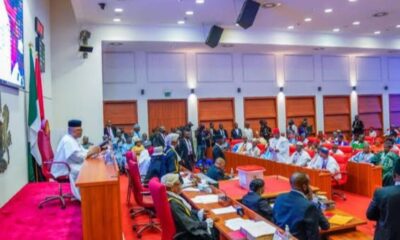
Senate Retains Two-Year Jail Term for PVC Trading, Raises Fine to ₦5m
-

 EFCC8 months ago
Lagos Court Jails Man 18 Months for Defrauding Sterling Bank of ₦30m
-

 Economy8 months ago
Naira Rebounds To ₦1,363.5/$
-

 Economy9 months ago
Naira Closes in the Red at ₦1,341.35/$